Don’t Trouble the Trouble (2026): Fahadh Faasil Charms In A Fantasy That Keeps Its Secrets Too Well
The most telling image in Don’t Trouble the Trouble isn’t the one the marketing sold you. It’s the sight of Suri, street magician, small-time crook, a man whose entire livelihood depends on misdirection, standing perfectly still while a child he cannot control rearranges the world around him. Shashank Yeleti’s film understands, at least conceptually, that the funniest and most unnerving thing about magic is the moment the trick stops being yours. What the film does with that understanding over two hours and thirty-eight minutes is where the arguments begin.

The Premise Is A Trapdoor, And The Film Knows It
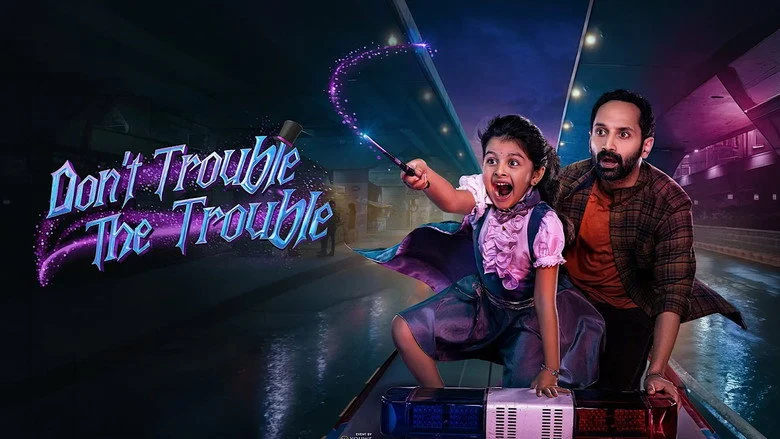
The setup is deceptively clean. Suri, played by Fahadh Faasil in what is being positioned as his full-fledged Telugu lead debut, stumbles into a magical incident involving Divya (Ssara Palekar), a young girl whose supernatural abilities flare violently whenever she is angered. The vanishing that triggers the plot isn’t a kidnapping in any conventional sense, it’s a consequence, and the film’s smartest instinct is refusing to explain the mechanism too early. Yeleti and co-writer Hamza Ali treat the magic as a pressure system rather than a rulebook, which keeps the first act genuinely unpredictable.
But unpredictability has a cost, and Don’t Trouble the Trouble pays it in the middle stretch. The city-spanning chaos that follows, Divya’s powers spiraling every time her temper does, is staged with real kinetic energy, yet the film never quite decides whether it wants to be a chase movie, a bonding drama, or a whimsical fable. That indecision is the film’s defining tension, and it’s a tension the audience feels physically across a runtime that Arka Media Works has allowed to stretch past the two-and-a-half-hour mark. Compare it to the tighter architecture of something like Sigma review, which at least commits to its genre contract even when the execution wobbles, and the difference in discipline becomes obvious.
Fahadh Faasil Is The Whole Engine, And The Film Knows That Too
Fahadh Faasil has spent the better part of a decade proving he can do almost anything, and Suri is a role engineered for his specific gifts: the flicker of calculation behind a con man’s grin, the way he can shift from charming to terrified without telegraphing the transition. There’s a sequence in the second act where Suri tries to calm Divya by performing a magic trick, the same kind of sleight-of-hand he’s used to fleece marks, and the camera holds on Fahadh’s hands rather than his face. It’s a small choice, but a revealing one. The film trusts his physicality to carry the emotional logic that the screenplay hasn’t fully worked out. When Suri realizes the trick isn’t working, the stillness that follows is the most honest moment in the movie.
The problem is that Ssara Palekar’s Divya is written as a mechanism more than a character. She’s angry, therefore things happen. She’s calm, therefore the plot pauses. The film never gives her the interiority that would make the central bond land, which means the third act’s emotional resolution, Suri finding purpose through his connection to her, arrives more as a structural obligation than an earned catharsis. Saurabh Sachdeva and Venkatesh Kakumanu are present in the cast, but the screenplay gives them so little to do that their scenes register as connective tissue rather than supporting performances. For a film that wants to be about companionship transforming a man, it’s oddly incurious about the person doing the transforming.
The Craft Is Confident, The Script Is Not
Yeleti’s direction has a real feel for texture, the film’s world is populated with enough lived-in detail that you believe Suri has been running small cons in these streets for years. The magic, when it erupts, is staged with a restraint that suits the UA13+ certification; this is a film that wants families in seats, not shock. But restraint becomes a liability when the screenplay needs escalation. The citywide chaos sequences, which should be the film’s showstoppers, are choreographed with a certain visual wit but staged without genuine danger. Divya’s powers feel like a plot device rather than a threat, and once you stop fearing the magic, you stop caring about the stakes.
This is where the comparison to Prem Keetanu verdict becomes instructive. That film also struggled to translate a promising premise into sustained momentum, but at least its failures were failures of ambition, it reached for something and missed. Don’t Trouble the Trouble often feels like it’s not reaching at all, content to coast on Fahadh’s charisma and the novelty of its central gimmick. The result is a film that is pleasant, watchable, and almost entirely frictionless, which, for a story about a man whose life is upended by forces he can’t control, is a strange kind of failure.
The Verdict
Don’t Trouble the Trouble is a film with a genuinely intriguing premise, a committed lead performance, and a director who understands atmosphere. What it lacks is the narrative rigor to turn those ingredients into something that accumulates rather than merely proceeds. The magic never becomes a metaphor, the bond never becomes the engine, and the ending arrives with a shrug rather than a punch. Fahadh Faasil fans will find plenty to admire in his work here, he’s doing more than the script asks of him, and doing it with apparent ease. But for a film that wants to be about the unexpected, it’s ultimately too predictable for its own good.
Rating: 2.5/5
Who should watch it: Fahadh Faasil completists, families looking for a gentle fantasy outing, and anyone who has already exhausted the better options in the genre this year.
Who should skip it: Viewers who need their fantasy to have stakes, their characters to have depth, or their two-and-a-half-hour runtimes to justify themselves.

Ankit Jaiswal is the Chief Author, covering Indian cinema and OTT releases with honest, no-filler criticism. An SEO strategist by background, he brings a research-driven approach to film writing, cutting through hype to tell you exactly what's worth your time.