Prem Keetanu (2026): Veer Pahariya Leads A Remake That Borrows The Chart But Not The Pulse
The problem with remaking Premalu is that you are not really remaking a plot. You are remaking a temperature. Girish A.D.’s original worked because it was loose, humid, and slightly unhinged, a love story told at the pitch of friends talking over each other in a crowded canteen. Prem Keetanu, Apoorv Singh Karki’s Hindi transplant, arrives with the same bones and a noticeably cooler blood supply. It is competent, cleanly assembled, and almost never dangerous. For a film whose teaser promised “romance, comedy, and madness, ” the madness has been politely escorted to the door.
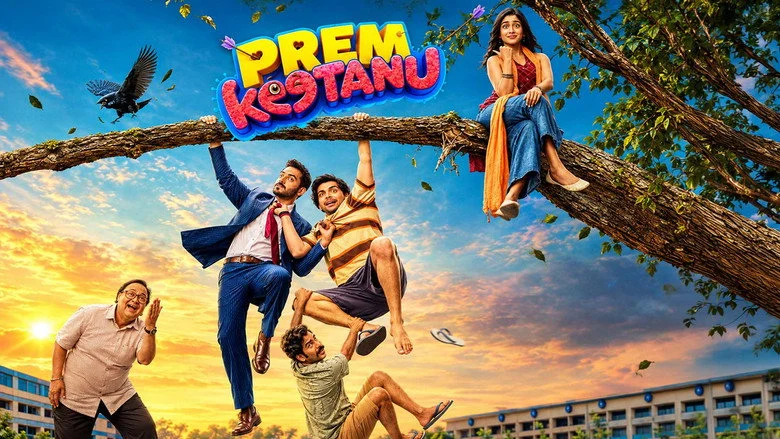
The Campus Is Right; The Chaos Is Sanitised
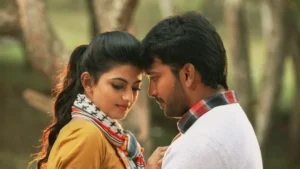
Karki, coming off the courtroom steel of Sirf Ek Banda Kaafi Hai and the series realism of Aspirants, clearly wants to stretch. The UP and NCR/Delhi-Gurgaon setting gives him texture to work with, and cinematographer Arjun Kukreti shoots the campus corridors with a warm, lived-in grain that sells the geography better than the screenplay sells the people. The film opens on young friendship, a love triangle, and the comic debris of college life, and in these early stretches, the staging is genuinely nimble. Watch how the friend group is introduced: bodies crowded into a single frame, dialogue overlapping, the camera refusing to cut on the joke so the awkwardness has room to breathe. That is a director who understands that ensemble comedy lives in the pauses between lines, not in the punchlines themselves.
The trouble is that the film trusts that staging to do work the writing hasn’t earned. The middle act, underachieving friends juggling love, career panic, heartbreak, and family expectation, is structurally sound and emotionally thin. Every beat arrives exactly where you expect it, which is fine for a genre piece, except that the original’s whole appeal was its refusal to behave. Here, the love triangle is set up with such symmetrical tidiness that you can map the third act from the first ten minutes. Trailer-level descriptions flagged “comedic misadventures”; what’s on screen is closer to comedic appointments.
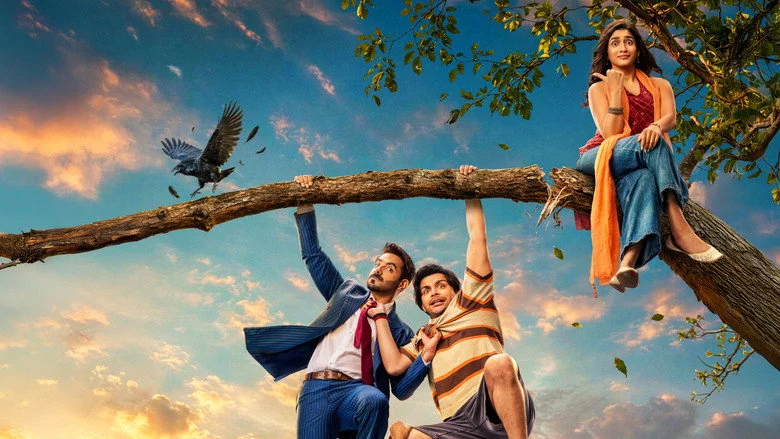
Pahariya Has The Face; He Needs The Friction
Veer Pahariya is positioned as the mischievous centre of gravity, and he has the correct instrument for it, an easy, slightly sheepish charm that plays well in two-shots. But the role demands a specific kind of helplessness, the ability to be genuinely pathetic in pursuit of someone who is only half-interested, and Karki keeps directing him toward likeability instead. There’s a difference between a rom-com lead who is a mess and a rom-com lead who is merely in a mess, and the film never quite decides which one it has.
Aparshakti Khurana, as ever, is the film’s most reliable pressure valve, his comic timing operates on a different clock than everyone else’s, and the scenes where he’s allowed to derail the scene are the ones that briefly suggest the movie this could have been. Aafiya Syed gets the harder job: she has to be the object of a triangle and a person inside it, and she’s better at the second than the script lets her be. Rakesh Bedi and Nikhil Vijay round out the ensemble with the professionalism you’d expect, though neither is given a scene that would survive a highlight reel.
For a sharper example of a film that lets its clues and its characters do equal work, the whodunit instincts of Maaruvesham review are instructive, that film at least understands that an audience stays for the mechanics, not the mood board.
Seven Songs, One Emotional Register
The soundtrack is the film’s most confident asset and its most conspicuous crutch. Seven tracks from the likes of Sachet Tandon, Parampara Tandon, B Praak, Armaan Malik, Papon, Jubin Nautiyal and others is a lot of emotional scaffolding, and “Ishq Ka Ghulam” is deployed as the designated heartbreak number with the subtlety of a stage cue. It works in the moment. It also means the film outsources its biggest feelings to playback rather than letting its actors sit in silence. The original Premalu earned its ache in rooms; this one earns it in montage.
That said, the mood-elevating quality audiences flagged in pre-release material is real. The film is an easy sit, 2h 18m that moves, a UA16+ certificate that suggests a little edge that the final cut mostly declines to use, and a youthful energy that never curdles into cynicism. If you’re looking for a comparable case of a film whose rural-romance framework never quite earns its own gravity, our take on Thella Kaagitham verdict covers similar terrain from a different angle.
The Remake Problem Nobody Solved
The online conversation around Prem Keetanu was never really about the film. It was about the OTT disappearance of Premalu ahead of release, and about casting choices that a section of the original’s fanbase found hard to accept. Those grievances are loud, but they’re not the movie’s actual failure. The actual failure is subtler: Karki and writer Deepak Kingrani have reproduced the original’s structure without its looseness, its warmth without its mess. The result is a film that hits every mark and lands very few of them.
It is not a bad movie. It is a movie that has been made correctly, which is a different and slightly sadder thing. The ensemble is game, the setting is well-observed, and there is a version of this, twenty minutes longer, ten jokes weirder, one lead performance less afraid of being unlikable, that would have justified the remake. That version isn’t on screen. For a broader look at how we’re grading this season’s theatrical output, our Hindi Comedy reviews keeps a running tally.
Verdict
Prem Keetanu is a watchable, well-mounted romantic comedy that never risks the messiness that made its source material worth remaking. Pahariya is charming but under-directed, Khurana is the film’s live wire, and the soundtrack does more emotional labour than the screenplay. Recommended for undemanding date nights and fans of the campus-romance template; skip it if you’ve seen Premalu and expect the same electricity, or if you want your comedies to actually surprise you.
Rating: 2.5/5

Ankit Jaiswal is the Chief Author, covering Indian cinema and OTT releases with honest, no-filler criticism. An SEO strategist by background, he brings a research-driven approach to film writing, cutting through hype to tell you exactly what's worth your time.