Momacu (2026): Jatin Sarna Trapped in Greed’s Darkest Comedy
Three men drag a stolen ATM into a tube well motor room on a freezing Haryana night, expecting a quick score. By dawn, their desperation and mistrust have spiraled into something far darker and infinitely more ironic than they bargained for.
Kuldeep Kunal’s Momacu traps its ensemble in a contained pressure-cooker that thrives on the collision between criminal ambition and human chaos. What emerges is a film that understands how greed corrupts faster than any external antagonist ever could.
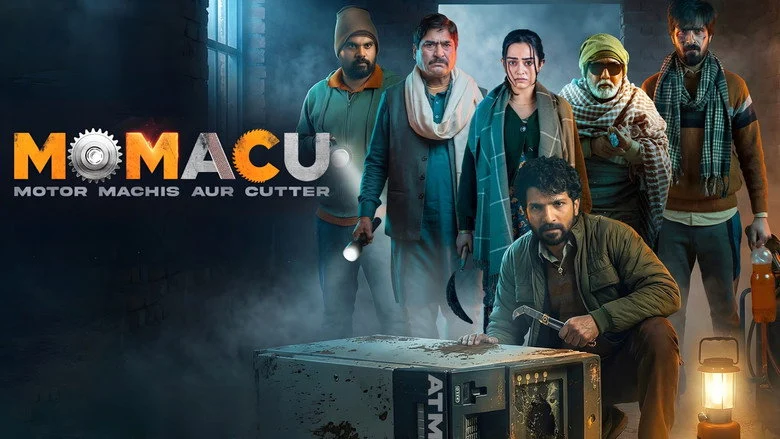
Jatin Sarna Anchors the Desperation Spiral
Sarna carries the weight of this survival scenario as the most visibly anchored performer in the ensemble. His presence in this tension-comedy setup avoids the conventional hero arc entirely, instead embedding him into a collective unraveling where no one wins.
Kuldeep Kunal’s Contained Ambition and Tonal Imbalance
The director’s strength lies in forcing a single premise, three men, one stolen ATM, one night, to generate its own escalating conflict without external rescue or intervention. The rural Haryana backdrop functions as structural spine, not decoration. Yet the film’s determination to blend dark comedy, suspense, and crime drama simultaneously risks diluting the thriller’s forward momentum when the jokes demand breathing room the genre rarely permits.
The Night Sequence That Builds and Collapses
The extended overnight sequence where the men attempt to crack open the ATM is where the film’s tonal ambition becomes visible. Exhaustion accumulates, mistrust festers, and their arguments escalate from practical disagreement into something darker. The setup works because confinement amplifies every fracture, escape becomes impossible not just physically but psychologically.
The dawn consequence arrives as genuine irony rather than plot twist, which is rare enough in crime thrillers. The film understands that greed’s cruelest punishment is often self-inflicted rather than handed down by law or rival criminals.
What complicates the execution is the tonal density itself. Dark comedy requires precision timing that thriller structure doesn’t always accommodate. When the film pivots between moments that should be darkly funny and moments that should be claustrophobic, the seams occasionally show, neither fully landing with the impact either registers independently.
For those seeking more analytical takes on Hindi cinema’s genre play, Hindi Thriller reviews across our archive reveal how often confinement scenarios prioritize spectacle over character collapse.
The Ensemble’s Invisible Architecture
Yashpal Sharma and Apoorva Arora anchor the visible ensemble presence, though the sources offer no scene-specific breakdown of their work. Their casting signals that the film functions as collective pressure-cooker rather than star vehicle, which proves more interesting than standard crime-drama hierarchy.
The Premise’s Politics Without Preaching
Rural Haryana’s economic desperation is the film’s unspoken political foundation. Three men steal an ATM not from ambition but from need, which complicates any easy moral positioning. The film doesn’t lecture about rural inequality; it simply lets it breathe as the reason these men risk everything for a locked metal box. That restraint matters.
Momacu works best for viewers comfortable with premise-driven stories where character pressure replaces action sequences, and where dark comedy can sit alongside genuine threat without resolving into farce. The tonal ambition occasionally strains the execution, but the core desperation remains visceral. Watch it for Sarna’s commitment to collective unraveling and Kunal’s refusal to deliver easy resolution, both are too rare in Hindi genre cinema.
Momacu proves that a contained crime scenario can generate real suspense when character mistrust matters more than external conflict, landing as a respectable 3.5 out of 5 for audiences willing to sit with ambiguous desperation.
The tonal DNA here shares ground with System review to institutional entrapment.
Both films understand how Haunted 3D verdict matters more than physical space.

Ankit Jaiswal is the Chief Author, covering Indian cinema and OTT releases with honest, no-filler criticism. An SEO strategist by background, he brings a research-driven approach to film writing, cutting through hype to tell you exactly what's worth your time.