Chevittorma (2026): Dileesh Pothan Anchors a Deathbed Drama That Refuses Easy Absolution
Leo Thaddeus opens his camera on a room where the only thing moving is breath. A wealthy farmer named Payyammal Varkichan lies failing, and beside him sits a woman who has made a vocation out of accompanying strangers into death. Theresia prays. She does not flinch. And in that refusal to flinch, Thaddeus locates the entire moral architecture of Chevittorma, a ninety-five-minute chamber piece that treats a deathbed less as a setting than as a pressure vessel.
What complicates the air in that room is that Varkichan is not alone with his mortality. His son George and George’s wife have returned after a ten-year absence, and their arrival is not a reconciliation. It is a vigil with a ledger underneath it. They are waiting. Everyone in the house knows what they are waiting for, and no one will say it.
When Forgiveness Becomes an Argument the Dying Man Refuses to Lose
The film’s central mechanism is deceptively simple: Theresia asks Varkichan to repent, to forgive, to release whatever has calcified inside this family before his body does it for him. He refuses. Not because he lacks the capacity, but because George is watching. To soften now, in front of the son who left, would be to concede that the decade of estrangement was his fault. Pride, in Thaddeus’s design, is not a character flaw. It is a negotiating position, and Varkichan will not vacate the table.
This is where the film separates itself from the broader run of deathbed dramas. The antagonist is not a person. It is inherited anger, a thing passed down so long ago that no one in the house can locate its origin, only its temperature. The screenplay keeps the past off-screen and trusts the present to carry the weight of it. Whether that trust pays off depends entirely on how much you’re willing to read into what the characters won’t say.
Dileesh Pothan Plays a Man Who Weaponizes Stillness
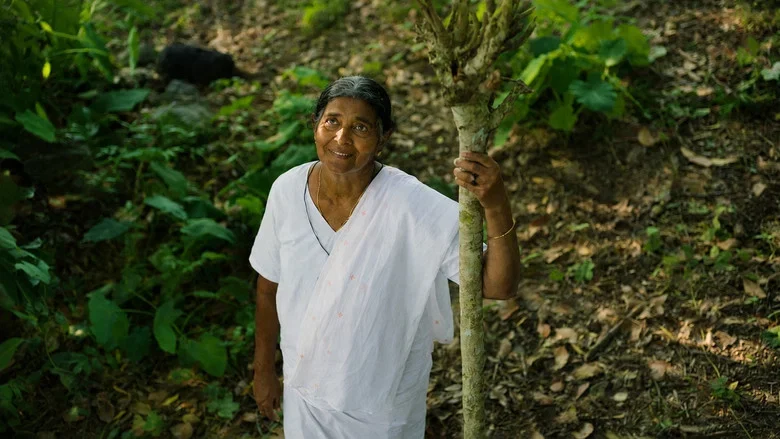
Dileesh Pothan, an actor-director whose screen presence has always carried the authority of someone who has already decided the argument before it begins, does something quietly vicious here. He plays Varkichan almost entirely in refusal. He does not raise his voice. He does not turn away. He simply declines, again and again, and the declining becomes a kind of performance in itself, a demonstration to George that the old man still controls the room.
The restraint is not the same register as what the actor brought to his work in Drishyam, where stillness was a strategy of concealment. Here it is a strategy of assertion. Varkichan’s silence is not hiding something. It is showing George exactly what he intends to take with him.
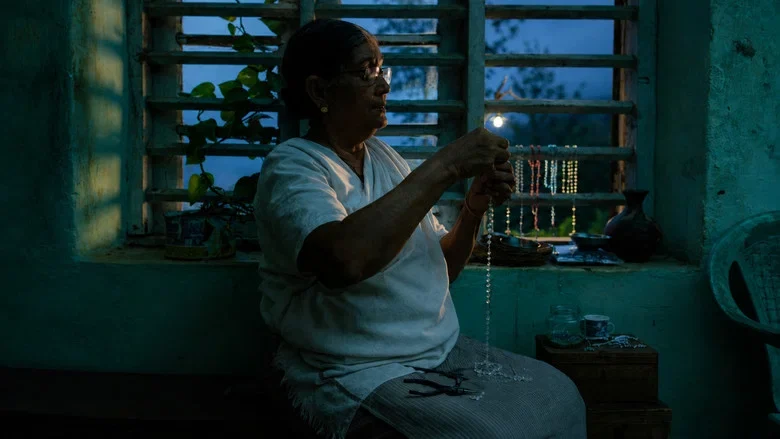
Pauly Valsan’s Theresia is the counterweight, and she plays it without sanctimony. Her prayers are not soft. They are insistent, almost procedural, as if she has done this enough times to know that the dying rarely come around on the first ask. When she presses Varkichan, she is not pleading. She is working. And the film’s moral pressure comes from the fact that she keeps working even after it becomes clear he will not move.
The Ten-Year Gap Is the Film’s Real Special Effect
George’s return is the structural hinge on which everything turns. The screenplay gives us no flashbacks, no explanatory monologue about what happened a decade ago. Instead, it gives us a man standing in a doorway, watching his father die, and the audience is asked to fill in the missing years from the way he holds his body. It is a gamble. It works more often than it doesn’t.
Where the film runs into trouble is in the middle stretch, where the confrontation between Theresia and Varkichan begins to circle. The arguments are the same arguments, restated with slightly different phrasing, and the ninety-five-minute runtime starts to feel less like compression and more like a held breath that the film is afraid to release. Just as the staging in Toxic occasionally mistook repetition for escalation, Chevittorma sometimes confuses persistence with progress.
The difference is that Thaddeus has a better reason for his repetitions. Varkichan’s refusal is not a plot obstacle to be overcome. It is the film’s subject. The question is not whether he will forgive. It is whether a man can die without forgiving and still be granted the dignity of the film’s attention. Chevittorma answers that question by refusing to answer it cleanly.
Milad Movahedi’s Score Knows When to Disappear
The most disciplined craft decision in the film is the one that is hardest to notice. Milad Movahedi’s score does not swell when Theresia prays. It does not underline Varkichan’s refusals with strings. It sits back and lets the room’s ambient silence do the work, and that silence is the film’s real soundtrack, the sound of a house where no one is saying what they mean.
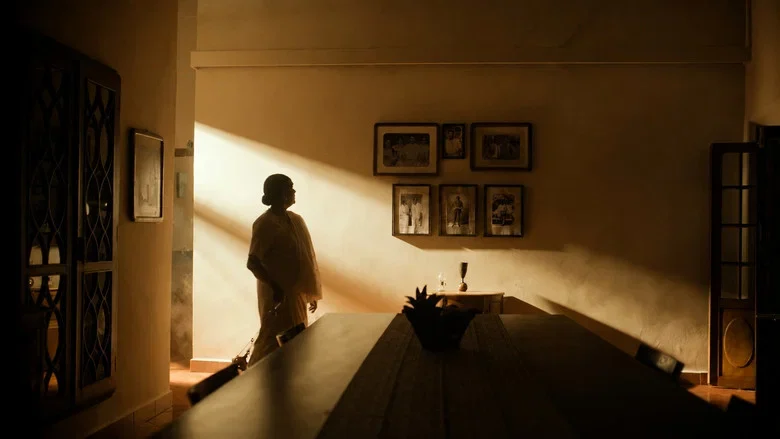
Thaddeus’s camera stays close, almost uncomfortably so, framing Varkichan and Theresia in the tight geometry of a sickroom where there is nowhere to look but at each other. The lighting is flat and unromantic, the kind of light that comes from a window that hasn’t been opened in a while. It is not a beautiful film. It is not trying to be.
Where the direction falters is in the film’s unwillingness to vary its own rhythm. The same shot-reverse-shot grammar that works in the first confrontation starts to feel like a tic by the third. A director with a sharper instinct for escalation might have found a way to make the repetition itself accumulate meaning. Thaddeus mostly just repeats.
Aali Knew How to Pay Off Its Tension; Chevittorma Isn’t Sure It Wants To
The comparison that keeps surfacing is to the kind of contained Malayalam drama that understands the difference between a slow burn and a stalled engine. The tension in Aali built toward a payoff that at least attempted to justify its own patience. Chevittorma is more interested in the patience itself, and that is a legitimate artistic choice, but it is not a choice without cost.
The cost is that the film’s ending arrives less as a resolution than as a cessation. The question of whether the family’s inherited anger can end before Varkichan dies is posed with real force. It is not answered with equal force. What we get instead is a final image that gestures toward the possibility of release without committing to it, and your tolerance for that gesture will determine your tolerance for the film.
This is the kind of patient, performance-led character study that has been quietly redefining the emotional register of contemporary Malayalam dramas, and it belongs in that conversation even when it doesn’t fully earn its place there. It is a film that trusts its actors more than its structure, and it is fortunate that its actors are worth the trust.
The Verdict: A Vigil Worth Attending, Even If You Leave Unsatisfied
Chevittorma is not a film that will be remembered for what happens. It will be remembered for the way Dileesh Pothan refuses to let his character become sympathetic, and for the way Pauly Valsan keeps praying anyway. That tension, between the refusal to change and the refusal to stop asking, is the film’s only real engine, and it is enough to carry ninety-five minutes, even when the screenplay isn’t.
What Thaddeus has made is a film about the impossibility of forcing someone to let go. Theresia cannot save Varkichan. She can only stay with him. And the film’s final, unresolved image suggests that staying, in the end, might be the only form of grace available. It is a small idea, delivered with small gestures, in a small room. Whether that is enough depends on whether you believe small rooms can hold large things.
Rating: 3 / 5
Some people die with their hands closed. The film knows this. It just doesn’t know what to do about it.

Ankit Jaiswal is the Chief Author, covering Indian cinema and OTT releases with honest, no-filler criticism. An SEO strategist by background, he brings a research-driven approach to film writing, cutting through hype to tell you exactly what's worth your time.