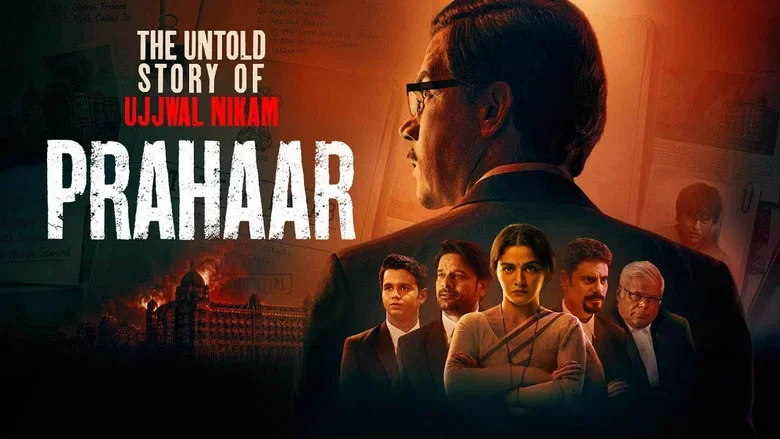
Prahaar (2026): Rajkummar Rao’s Disciplined Prosecution Anchors a Courtroom Drama That Refuses to Blink
Avinash Arun’s camera finds Rajkummar Rao in the corridor outside the special court, papers bundled under one arm, shoulders squared against a hallway of cameras he never asked for. The film’s central gamble announces itself in that stillness: can a man win a war of evidence without ever raising his voice?
The Chargesheet That Became a Weapon
Maddock Films opens on the smoking aftermath of 26/11, then pivots hard into the unglamorous machinery of prosecution. Ujjwal Nikam’s decision to file a single consolidated chargesheet rather than fragmenting the case across jurisdictions becomes the film’s structural spine, a procedural choice that doubles as dramatic architecture.
It is a smart compression strategy. By refusing to dramatize every strand of the investigation, the screenplay keeps its eye on the one arena where the verdict will actually be decided, the courtroom.
When a Defendant’s Denial Is the Only Weapon Left
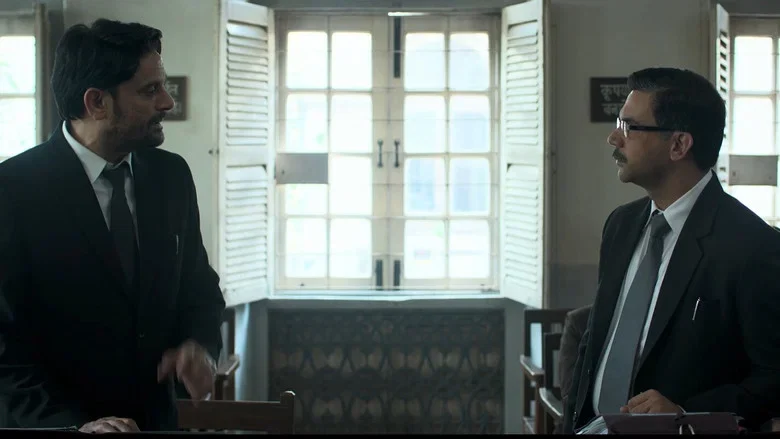
Lalit Prabhakar plays Ajmal Kasab not as a theatrical monster but as a man who keeps changing the story. His denials land with the flat affect of someone who has understood that ambiguity itself is a defence strategy, and the film’s tension comes from watching the prosecution try to pin down a moving target.
The screenplay resists the kinetic sensationalism that often overtakes legal dramas, opting instead for a deliberate, suffocating dread. Where a lesser film would cut away to the attack for adrenaline, Avinash Arun holds on faces in the dock.
The adversarial structure gains real weight from Sikandar Kher’s Qureshi, who gives the defence a procedural seriousness that prevents the conflict from becoming a one-sided morality play. His cross-examinations are built on small, precise objections rather than grandstanding.
Rajkummar Rao’s Restraint and the Accent That Slips
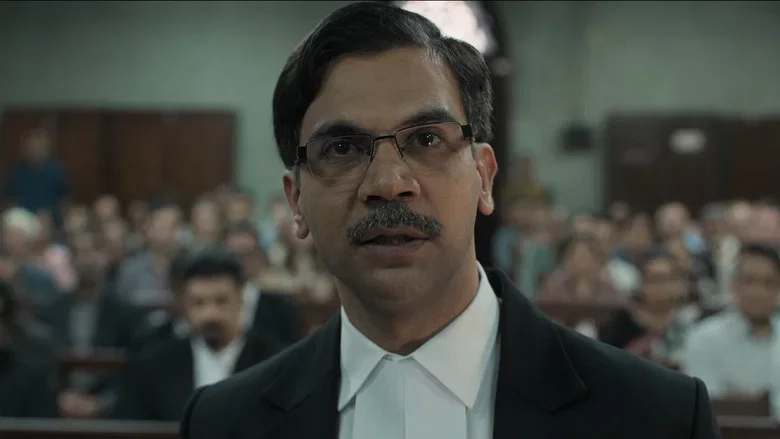
Rao’s Nikam is built from controlled courtroom behaviour: the way he absorbs an objection without flinching, the way his hands stay flat on the desk when he could be pointing. The performance recalls the psychological weight of his turn in DC, where composure was also the character’s only armour.
But the accent is a genuine problem. In several exchanges the Marathi-inflected cadence slides back toward Rao’s familiar urban register, and the illusion of a consistent voice fractures mid-scene. It is a small crack that widens every time the camera holds on him too long.
Jaideep Ahlawat’s Nazzar arrives late but leaves a mark, particularly in a sequence that folds a Sahir Ludhianvi line into the legal rhetoric. It is the one moment where the film allows ideology to enter the room without turning into a lecture.
The Personal Track That Never Finds Its Pulse
Wamiqa Gabbi is given the film’s quietest register, a domestic counterpoint to the public case, and she plays it with a grounding presence. The problem is structural, not performative: her character has no independent arc, only reactions to Nikam’s exhaustion.
Compared to the moral fallout analyzed in Kalpana Aur Yatharth, where the personal and the procedural bled into each other, this track remains sealed off. Every time the film cuts away from the courtroom, the temperature drops.
The judge, played by Aashish Vidyarthi, anchors the proceedings in formal procedure rather than allowing the film to become a two-man shouting match. It is unglamorous work, and it holds the middle section together.
Avinash Arun’s Procedural Discipline
The direction keeps the camera close and the cutting patient, letting objections and testimony generate suspense rather than score cues. Just as he demonstrated a tighter spatial discipline in Nayyi Navelli, the filmmaker strips away decorative camera moves here to prioritize raw psychological friction.
For a mid-budget production, the technical execution is confident, the courtroom feels like a real room with bad lighting and worse acoustics, not a set. The film understands that bureaucracy is its own kind of thriller.
What it never solves is rhythm. The second half depends on successive denials and rebuttals, and without a stronger emotional counterweight, the repetition starts to feel like a transcript being read aloud.
Maddock’s Mid-Budget Bet and the Remake Economy
Dinesh Vijan’s Maddock Films has staked a growing portion of its slate on mid-budget, performance-led dramas rather than franchise spectacle, and this film is a clear test of whether that model can sustain a theatrical release built on legal procedure.
The postponement from its earlier August date to October suggests the studio was hedging against a crowded calendar, a familiar move in a market where original IP increasingly competes with the remake pipeline. Rao’s box-office leverage is real, but it has been built on genre-hopping rather than a single franchise.
This patient character study signals a welcome tonal maturity across contemporary hindi dramas, though whether audiences will pay for a film that refuses to raise its voice remains the open question.
The Verdict That Arrives Without Catharsis
The conviction lands as institutional justice rather than personal triumph, and the film’s refusal to give Nikam a moment of vindictive release is its most honest choice. The system worked, slowly, and the cost is written on a face that has stopped being angry.
What lingers is not the verdict but the silence after it, a prosecutor packing his files while the cameras outside keep rolling. Prahaar is a disciplined, occasionally frustrating film that trusts procedure over spectacle, and in doing so, it asks whether justice is something you win or something you simply endure.

Ankit Jaiswal is the Chief Author, covering Indian cinema and OTT releases with honest, no-filler criticism. An SEO strategist by background, he brings a research-driven approach to film writing, cutting through hype to tell you exactly what's worth your time.