Selvi (2026): Anjali Patil’s Exhaustion Drama Tests the Limits of Caregiving
There is a moment early in Sailesh Rathnakumar’s Selvi when the title character finishes wiping down a bathroom floor that isn’t hers, checks a medication schedule that belongs to someone else’s mother, and then checks her own watch with the quiet panic of a woman who has already lost the argument with time. The film opens not with a declaration but with a routine, the click of a door latch, the rustle of plastic gloves, the soft negotiation with an elderly patient who does not want to eat. Within ten minutes, we understand that Selvi’s life is measured in increments of other people’s needs.
Anjali Patil plays Selvi, a home-care nurse who moves between households with the efficiency of someone who has long since stopped expecting thanks. The film’s inciting incident arrives without fanfare: her friend Kavitha collapses, and Selvi absorbs her shifts. No villain enters the frame. No dramatic music swells. The crisis is logistical, and that is precisely the point.

When the Antagonist Is a Calendar, the Drama Lives in the Body
Rathnakumar and co-writer Bargav Sridhar have constructed a screenplay that treats exhaustion as a structural force. Selvi’s day expands, one more patient, one more set of keys, one more family member who assumes she will say yes. The film’s middle section becomes a study in accumulation, each new obligation landing with the dull thud of inevitability rather than shock.
This approach recalls the spatial discipline Rathnakumar brought to his earlier work on Toxic, where he demonstrated a willingness to let tension build through geography rather than dialogue. Here, he strips away even that film’s occasional visual flourish, favoring handheld intimacy and a color palette that seems to drain with Selvi’s energy.
The screenplay resists the temptation to introduce a villainous employer or a cartoonish social worker. The opposition is systemic: the economics of care work, the guilt of saying no, the way love and duty become indistinguishable from obligation. It is a mature choice, though it leaves the film without a conventional pressure-release valve.
Anjali Patil’s Performance Is a Study in Controlled Collapse
Patil carries the film with a physical vocabulary that grows heavier by the scene. Watch her hands in the first act, quick, precise, professional. By the midpoint, they linger a beat too long on doorframes. By the final third, she is holding herself upright with the visible effort of someone who has forgotten what rest feels like.
The role demands a performance built on depletion rather than revelation, and Patil delivers it without a single scene of theatrical breakdown. Her Selvi does not weep in bathrooms or scream at the sky. She simply keeps moving, and the film’s tragedy is that no one notices the cost.
There is a supporting turn from Swathy Krishnan as Kavitha, whose sudden collapse functions as both plot mechanism and emotional wound. Krishnan’s screen time is limited, but her absence, the empty space she leaves in Selvi’s routine, becomes a character in itself. The restrained physical exhaustion Patil brings to the final act recalls the psychological weight carried by Parineeti Chopra in Reporting Live, another recent film where a woman’s body becomes the site of her struggle.
Where the Film’s Stillness Becomes Its Greatest Strength, and Its Risk
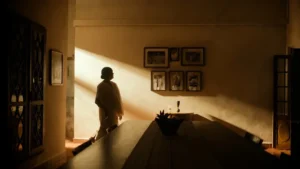
Rathnakumar’s camera rarely leaves Selvi’s face, and when it does, it is to show us what she cannot see: the other patients waiting, the phone calls she misses, the life she is not living. The film’s visual grammar is one of entrapment, with doorways and corridors framing her in increasingly narrow compositions.
The sound design is equally disciplined. There is no swelling score to tell us when to feel. Instead, we hear the hum of fluorescent lights, the ticking of a wall clock, the labored breathing of elderly patients. It is a choice that could feel austere, but it earns its emotional weight through accumulation.
The editing, however, reveals the film’s central tension. At 97 minutes, Selvi is admirably compact, yet the second half struggles to find escalation without repetition. The episodic structure, one home, then another, then another, begins to feel like a loop rather than a spiral. The film’s commitment to realism is noble, but realism can become its own kind of trap.
The Uncomfortable Question the Ending Refuses to Answer
Without disclosing the film’s resolution, it is fair to say that Selvi ends not with a solution but with a recognition. The final scenes ask whether caregiving can ever be sustainable when it is built on the assumption that women will always absorb the cost. The film does not answer this question. It simply holds it up to the light and lets us sit with the discomfort.
This is where Selvi diverges from more conventional social dramas. It resists the catharsis of a villain defeated or a system reformed. Instead, it offers something closer to a portrait, a woman, a job, a life that cannot be neatly resolved. The thematic kinship with films like Equal is evident, though Selvi is more disciplined in its focus, refusing to dilute its central character study with subplots that might offer easier emotional payoffs.
The film’s quiet refusal to console is both its integrity and its limitation. It signals a welcome tonal maturity across contemporary tamil dramas, but it also risks leaving audiences with nowhere to place their investment. A film can be honest and still be unsatisfying.
The Verdict: A Film That Demands Patience and Rewards It Unevenly
Selvi is not a film that will win over skeptics of slow, observational drama. Its pleasures are cumulative, its rewards delayed. But for viewers willing to sit with its rhythms, Anjali Patil’s performance offers a portrait of labor and love that lingers longer than its runtime suggests.
The film’s greatest achievement is its refusal to sentimentalize caregiving. It shows the work, the physical repetition, the emotional erosion, the way a life can be consumed by the needs of others. Its greatest weakness is a second half that mistakes repetition for escalation, circling its themes rather than deepening them.
Rating: 3 / 5
In the end, Selvi asks us to watch a woman who cannot stop giving, and to ask ourselves how long we would last in her shoes. The answer, the film suggests, is not long. And the fact that we rarely ask the question at all is the film’s quiet indictment.

Ankit Jaiswal is the Chief Author, covering Indian cinema and OTT releases with honest, no-filler criticism. An SEO strategist by background, he brings a research-driven approach to film writing, cutting through hype to tell you exactly what's worth your time.