
Reporting Live (2026): Parineeti Chopra Drives A Grimy, Uneven Sand-Mafia Thriller
The opening minutes drop us straight into the newsroom hum, a young reporter chasing a tip that smells bigger than it looks, her cameraman trailing behind with the weariness of a man who has seen too many dead ends. Dhruv Tripathi’s Reporting Live wastes little time establishing its stakes: illegal sand mining, a racket with money and muscle behind it, and two journalists who have no idea how deep the hole goes. The setup is lean, almost procedural in its efficiency, and that’s both its strength and its first warning sign.
Parineeti Chopra’s reporter is all forward momentum, the kind of ambition that mistakes danger for opportunity. Beside her, Deven Bhojani’s cameraman carries the weight of experience, not cowardice, exactly, but a bone-deep awareness of what happens when you poke the wrong hive. Their dynamic is the film’s engine, a push-pull between the need to tell the story and the instinct to survive it. It’s familiar territory, but the performers make it breathe.
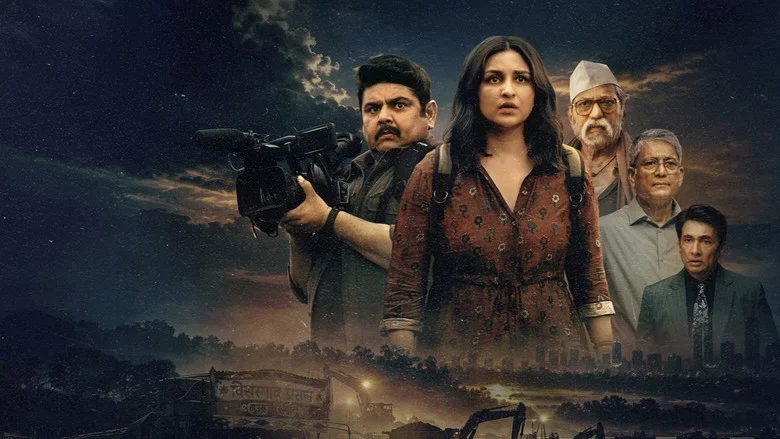
When The Story Becomes The Trap, The Thriller Finds Its Pulse
The middle stretch is where Reporting Live tightens its grip. The reporters move deeper into the sand-mining network, and the film smartly shifts from investigation to entrapment, the deeper they dig, the harder it becomes to climb out. It’s a classic escalation, but Tripathi handles it with a grim patience, letting the noose tighten rather than yanking it. The syndicate remains a faceless force for much of the runtime, which works as atmosphere but leaves the film without a human antagonist to truly fear.
That absence is felt most in the confrontations, which rely on the threat of violence rather than its embodiment. The screenplay, co-written by Tripathi and Mihir Jadhav, understands that institutional menace can be more chilling than a single villain, but it never quite finds a face to anchor that dread. The result is a film that simmers without ever fully boiling.
The Stillness That Carries The Weight
Chopra does her best work in the quieter moments, a clenched jaw during a phone call, the way her eyes dart when she realizes the danger is closer than she thought. She’s playing a woman who believes the story matters more than her safety, and she commits to that conviction without turning it into martyrdom. It’s a performance built on restraint, and it’s the film’s most reliable asset.
Bhojani, meanwhile, is the film’s conscience. His cameraman isn’t a hero, he’s a man who wants to go home, and Bhojani plays that reluctance with a lived-in exhaustion that grounds the film’s more heightened moments. The veteran ensemble, including Amol Palekar and Adil Hussain, hover at the edges without ever getting enough screen time to register as more than thematic signposts. It’s a waste of talent, and the film feels thinner for it.
A Grimy Visual Palette That Knows What It Wants
Tripathi’s direction favors a muted, almost documentary-like visual approach, handheld framing that keeps the camera close to the reporters’ faces, natural light that never flatters, and a color palette drained of warmth. It’s a deliberate choice, one that echoes the spatial discipline he brought to Toxic, though here the grit feels less stylized and more functional. The film wants to feel real, and for the most part, it does.
Where it stumbles is in its pacing. The first half moves with purpose, but the second half starts to repeat itself, another close call, another narrow escape, another reminder that the syndicate is everywhere. By the time the climax arrives, the tension has been stretched so thin that it threatens to snap. The film’s 115-minute runtime isn’t excessive, but it feels longer than it should.
The Uncomfortable Cost Of Telling The Truth
What Reporting Live gets right is its refusal to romanticize the work. Journalism here isn’t a noble calling, it’s a grind, a series of compromises, and sometimes a death sentence. The film’s moral center is simple but effective: the story matters, but so does survival, and the two are often at odds. It’s a tension that echoes the ethical knots of Drishyam, though without that film’s narrative precision.
The ending, without spoiling anything, lands with a quiet resignation rather than a triumphant punch. It’s a choice that feels honest, if not entirely satisfying, a reminder that exposing the truth rarely comes with a clean victory. The film’s final moments suggest that the real cost of reporting isn’t just physical danger, but the slow erosion of the belief that any of it matters.
A Thriller That Trusts Its Audience, Even When It Shouldn’t
For all its strengths, Reporting Live never quite becomes the film it could have been. The syndicate remains a shadow, the supporting cast is underused, and the pacing sags in the back half. But there’s something admirable about its restraint, its refusal to turn a story about sand mining into a spectacle. It’s a film that trusts its audience to feel the weight of the story without being told how to feel it.
Chopra’s performance, in particular, deserves more than the film gives her. She’s playing a woman who believes in the power of the story, and she sells that belief without ever making it feel naive. It’s a reminder of what she’s capable of when given material that demands more than charm. The film may not be a triumph, but her work in it is a quiet victory.
The Verdict: A Solid, If Uneven, Entry In The Streaming Thriller Space
Reporting Live is a film that knows what it wants to say but isn’t always sure how to say it. It’s a gritty, grounded thriller with a strong central performance and a genuinely unsettling premise, but it lacks the narrative sharpness to fully deliver on its promise. The sand mafia is a worthy adversary, faceless, pervasive, and terrifyingly real, but the film never finds a way to make that threat feel personal.
What it does offer is a reminder that some stories are worth telling, even when the telling costs more than expected. It’s a film that sits comfortably alongside the current wave of contemporary Hindi thrillers, even if it doesn’t quite rise above them. For viewers who appreciate a slow-burn investigation over explosive set pieces, there’s enough here to warrant a watch. For everyone else, it’s a solid, if unremarkable, addition to the Netflix queue.
Rating: 3 / 5
In the end, Reporting Live is less about the story it tells and more about the cost of telling it, a film that understands the weight of the truth, even if it never quite finds the strength to carry it.

Ankit Jaiswal is the Chief Author, covering Indian cinema and OTT releases with honest, no-filler criticism. An SEO strategist by background, he brings a research-driven approach to film writing, cutting through hype to tell you exactly what's worth your time.