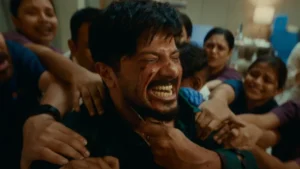
Dacoit (2026): Sesh’s Revenge Drama Hinged on Bilingual Action Craft
A man walks out of prison with one objective: destroy the woman who framed him. Adivi Sesh’s convict hunts through a landscape of betrayal and violence, his mission narrowing to a single point of vengeance against his deceitful ex-girlfriend. The bilingual Telugu-Hindi action drama arrives with the weight of a personal reckoning, not a sprawling narrative, revenge stripped to its functional core.
Shaneil Deo’s direction pivots on a familiar geometry: prison, betrayal, and the geometry of retribution. What matters here is not whether the story surprises, but whether the filmmaking language itself justifies the repetition.

Sesh’s Lean Performance Carries the Convict’s Fixation
Adivi Sesh anchors the film as a man who has learned to compress emotion into purpose. His convict moves through the narrative with the clarity of someone who has spent years in a cell perfecting one thought. The performance works best when dialogue recedes and physicality speaks, a body language shaped by incarceration and narrowed intention.
Sesh’s work here trades breadth for specificity. He commits fully to the singular drive, though the script offers limited room to explore the fractured interior of a man consumed by vengeance.
Deo’s Direction Anchored in Action Staging Over Emotional Nuance
Shaneil Deo demonstrates control over action sequences and spatial choreography, constructing encounters with architectural precision. The bilingual shoot itself signals ambition, executing consistent geography and performance across two languages demands technical discipline. Yet the screenplay struggles to deepen the psychological terrain between revenge beats, leaning on plot mechanics rather than character excavation.
Deo’s strength lies in kinetic design; his limitation appears in moments demanding introspection.
Action Drama Staging Drives the Narrative Forward
The film’s primary obligation, action drama execution, centers on encounter design and the spatial logic of pursuit. Sequences are constructed to emphasize geography: the convict moving through recognizable spaces with tactical awareness. Stunt coordination prioritizes coherence over spectacle, building confrontations that track cause and effect rather than visual excess.
The bilingual production creates natural opportunities for location expansion. Telugu and Hindi sequences use distinct environments to signal the character’s territorial expansion, a practical craft choice that doubles as narrative geography. This technical discipline, maintaining spatial continuity across language and location, becomes the film’s most evident production virtue.
Romance functions as the secondary current, not the primary fuel. The ex-girlfriend exists as the object of pursuit rather than a fully drawn antagonist; her deceit generates the engine, but her character lacks the dimensionality to sustain dramatic weight. This choice, treating romance as motive rather than exploration, reflects a screenplay that prioritizes plot forward motion.
Mrunal Thakur and Anurag Kashyap Navigate Thin Character Space
Mrunal Thakur steps into the role of the ex-girlfriend, a woman defined primarily by her betrayal. Her character anchors the central conflict, yet the screenplay confines her to reactive positioning. Thakur executes what’s written without excess, she becomes a focal point rather than a counterforce.
Anurag Kashyap enters as a supporting presence, his casting weight signaling a film conscious of ensemble gravity. His appearances carry the authority of an actor who has inhabited complex roles, though the limited material prevents deep examination of his contribution.
If you’re seeking a revenge narrative built on craft precision rather than emotional excavation, this film delivers functional cinema. The opening day box office, over Rs 15 crore globally, per Devdiscourse, suggests audience interest in the property, though pre-release estimates circled a worldwide theatrical business around 30 crore. Skip it if character depth matters more than action staging.
Dacoit: Ek Prem Katha constructs its revenge architecture with technical competence, executing a bilingual action drama that privileges kinetic clarity over psychological ambiguity, a solid 2.5 out of 5 that satisfies as craft, not as story.
The bilingual action-drama approach recalls how other recent Telugu crossovers have balanced regional and national markets through location and language specificity, worth exploring in Telugu Action reviews for pattern recognition.
Thakur’s confinement to reactive antagonist positioning echoes similar casting choices in Love Insurance review, where character limitation becomes a structural liability.
Both this film and Vaazha II verdict demonstrate how sequels and revenge narratives struggle when technical execution outpaces character development.

Ankit Jaiswal is the Chief Author, covering Indian cinema and OTT releases with honest, no-filler criticism. An SEO strategist by background, he brings a research-driven approach to film writing, cutting through hype to tell you exactly what's worth your time.