Made in Korea (2026): Priyanka Mohan’s Seoul Detour Remains Stubbornly Tamil
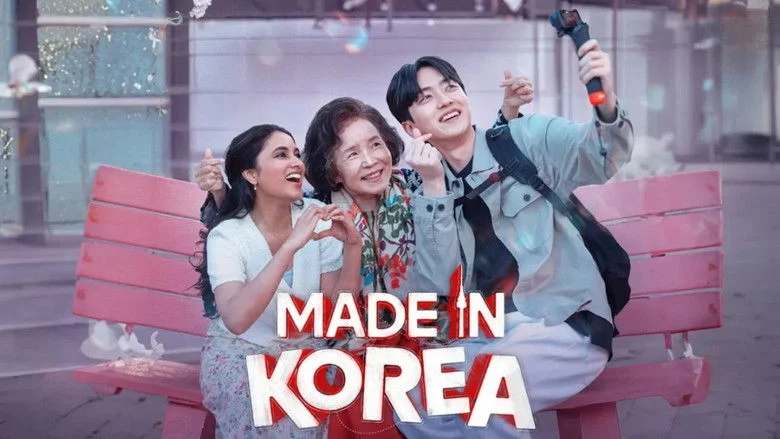
Shenba boards a plane to Seoul with nothing but a betrayed heart and borrowed courage, only to discover that her boyfriend’s scam has left her stranded in a country where she doesn’t speak the language and has no money. What begins as a survival story in South Korea quickly reveals itself as a deeply inward journey, one that refuses to genuinely engage with the culture surrounding it.
Ra. Karthik’s directorial effort lands somewhere between earnest and hollow, a coming-of-age drama that mistakes emotional beats for character development and confuses geographical displacement with authentic cultural exploration.

Priyanka Mohan’s Limited Radius
Mohan carries the film through sheer determination rather than nuance. Her airport scene, the mix of elation and hesitation before boarding solo, catches something genuine about a young woman stepping into the unknown. Yet by the time she’s tending to Yeon-ok or confronting loss in the closing restaurant sequence, her emotional palette feels constrained, hitting the same notes of wide-eyed vulnerability without discovering deeper registers.
The criticism lands precisely: “Priyanka Mohan travels all the way to Seoul, South Korea just to discover that her acting range and the plot are both still ‘Made in Tamil Nadu.'” Her caretaking diligence registers, but never evolves beyond dutiful affection.
Karthik’s Direction Captures Arc, Misses Authenticity
The director understands self-discovery as a structural principle. Shenba’s journey from scammed outsider to restaurant co-owner mirrors genuine resilience. Yet his treatment of K-Pop culture exposes a fatal laziness, a filmmaker who watched a few BTS videos and believed that qualified him as cultural authority. The Seoul he depicts feels borrowed, surface-level, a backdrop rather than a living ecosystem.
Karthik’s linear screenplay functions without plot holes; Mani’s betrayal resolves logically through deduction. But functionality isn’t vision.

Coming-of-Age Drama That Settles for Safe Ground
The film’s core strength lies in how it traces Shenba’s progression from victimhood to agency. Meeting Yeon-ok, building the restaurant, forming friendships with locals, each beat marks tangible growth. The restaurant success especially works as metaphor, a foreign woman creating something that feeds both her new community and her own sense of belonging.
Where genre execution falters is in emotional specificity. Yeon-ok’s fake paralysis reveal arrives with all the surprise of a spoiler you’ve already read, unoriginal, predictable, and designed to manufacture pathos rather than earn it. The twist serves plot mechanics, not character truth.
That closing fade-out, where Yeon-ok loses opacity in the restaurant, carries tear-jerking production value. The cinematography here feels genuinely considered. Yet the scene asks us to grieve someone we’ve watched only through Shenba’s eyes, never fully inhabiting her own interior world. Emotional manipulation through editing is not the same as earned emotional resonance.
Park Hye-Jin and Baek Si-hoon Ground the Film
Park’s Yeon-ok becomes the film’s unexpected emotional center, her fake illness backstory somehow more interesting than the premise deserves. She and Mohan achieve something the script doesn’t quite support, a genuine grandmother-granddaughter shorthand, where silences communicate more than dialogue. Their restaurant partnership feels like the film’s only truly lived relationship.
Baek Si-hoon’s Heo Jun-jae, the vlogger who bails Shenba from jail, functions as convenient plot mechanism rather than character. His role, capturing video, arranging lodging, facilitating opportunity, maps perfectly onto a savior archetype the film never complicates. He exists to solve problems, not to surprise.
Audience Reception: Sweet But Superficial
The film finds its target. Viewers seeking a sweet story of an Indian girl making do in Korea report satisfaction; audiences dreaming of Seoul themselves recognize their fantasies reflected onscreen. That emotional closing sequence resonates despite its manipulative construction, offering catharsis for anyone who’s felt displaced or alone.
But critics rightfully push back on the superficiality. Authenticity matters when your film is literally about cultural displacement, yet this one treats Korean reality as decoration, a set dressing for what remains fundamentally a Tamil Nadu story. As one publication observed, “The only thing ‘Seoul-ful’ about this film is the relationship between Priyanka Mohan and the Korean grandmom, ” which itself is the narrowest praise possible.
Films exploring cross-cultural adaptation deserve more ambition than what’s on display here. Karthik captures moments of genuine growth without interrogating what growth actually costs in foreign terrain, what it means to build a life when your past remains geographically severed, or how to navigate belonging when you’ll never fully assimilate.
For Netflix viewers seeking comfort-watch coming-of-age cinema with minimal friction and maximum sentimentality, this delivers. The chemistry between Mohan and Park works, the restaurant montage charms, and the final scene will extract tears through sheer production design. If you’re in the mood for an unchallenging story about resilience and friendship, the streaming platform is the right venue for it.
Explore more perspectives on Tamil Drama reviews and similar narratives crafted with cultural intent.
Skip if you demand authenticity from films built on cultural displacement; watch if you’re content with the feeling of a story rather than its actual substance. On Netflix, the low-commitment format at least matches the film’s lightweight approach.
Made in Korea is a competent but hollow coming-of-age drama that mistakes emotional scenery for character growth, a 2.5 out of 5 experience that younger audiences will embrace while cinephiles rightfully demand more from stories about belonging in foreign lands.
The similar emotional manipulation appears in Dacoit review, though that film grounds its sentiment in stakes.
For more on how Tamil narratives abroad fare under directorial scrutiny, Love Insurance verdict similarly struggles with cultural authenticity.

Ankit Jaiswal is the Chief Author, covering Indian cinema and OTT releases with honest, no-filler criticism. An SEO strategist by background, he brings a research-driven approach to film writing, cutting through hype to tell you exactly what's worth your time.