Drones (2026): Dravid Selvam Anchors a Wildly Uneven Surrealist Gamble
A drone named Sampangi hovers over an old mansion at dusk, and inside a boy mistakes a stranger’s beauty for destiny. That single act of technological voyeurism ignites R. Raghav Mirdath’s Drones, a film that wants to be a horror comedy, a sci-fi lark, and a moral essay all at once.
When Voyeurism Becomes the Engine of a Haunted Mansion
The setup is seductively strange. Suspended astrophysics student Kish and his friends Rush and Dush hole up in an eccentric scientist’s locked-down house nicknamed the Black Hole, then hijack his drone to spy across town.
What the lens finds is Prakruthi, a miniature artist framed in a mansion window like a storybook illustration. Mirdath stages the discovery through remote aerial perspective rather than a conventional meeting, making the camera itself complicit in the desire that follows.
That spatial divide between scientific confinement and supernatural mystery gives the film its cleanest visual architecture. The gap between the Black Hole’s sterile walls and the mansion’s haunted warmth is where the tension genuinely lives.
A Courtship Ritual That Repeats Until the Joke Wears Thin
Men who meet Prakruthi follow an identical script: poems, dolls, rings, and pledges to love her even when her hair turns white. The repetition is clearly deliberate, turning instant attraction into a comic pattern that exposes how hollow the gesture really is.
But a gag only sustains itself if each iteration escalates. Here the ritual circles rather than builds, and the film’s comic rhythm starts leaning on the audience’s patience instead of sharpening the absurdity.
Meanwhile the Inspector thread, a forty-year-old bachelor cursed so that any woman he sincerely says “I love you” to will die, runs parallel without ever properly colliding with the main plot. It is a strong comic idea stranded in its own lane.
The middle stretch accumulates the scientist, the sleepwalking student, the witch, and the doll transformations without a clear plan for moving them anywhere. Momentum sags precisely where the film should be tightening its grip.
Anjali Nair Turns the Witch’s Lair Into a Moral Arena
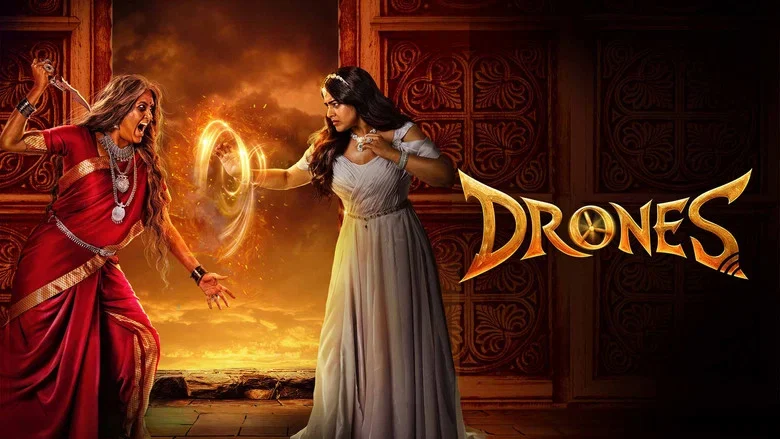
The film’s strongest sequence arrives when Rush finally confronts the witch. Anjali Nair plays the moment with a flat, unadorned steadiness, no raised voice, no theatrical fury, just a young woman stating plainly that society’s narrow definition of beauty causes real emotional damage.
Her physical stillness against the witch’s theatrical menace flips the scene’s power dynamic. Devadarshini, for her part, balances comic energy with genuine threat, shifting register between cackling hostess and supernatural authority without losing either.
What makes the confrontation land is its spatial intimacy. Two women in a cluttered room, one arguing, one listening, and the horror machinery quietly becoming a social argument. It is the only moment where the film’s genres fully cohere.
Dravid Selvam’s Kish, by contrast, carries the romantic blindness that drives everything. His performance leans on boyish self-deception, the eyes that light up at the window but slide past the friend standing right beside him. That blankness in Rush’s direction is the point, and Selvam plays it with an offhandedness that serves the theme even as it limits his range.
The restrained physical exhaustion he brings to the closing stretch recalls the psychological weight of his turn in Once More, though here the emotional register stays shallower and more reactive.
Where the Direction Loses Its Escape Route
Mirdath’s instincts behind the camera are generous. He gives every eccentric character room to breathe, uses props as comic carriers, and trusts the drone’s viewpoint to bridge science fiction and fantasy. The problem is generosity without discipline.
Just as he demonstrated tighter spatial control in Prahaar, the filmmaker knows how to build a contained world. But here he never decides which thread is primary, so the film drifts between them instead of driving forward.
The cinematography, unnamed in any credits I could verify on screen, does its best work in the contrast between the Black Hole’s clinical interiors and the mansion’s amber-lit warmth. Yet the visual scheme never develops beyond that initial opposition.
The score and songs remain anonymous in the experience of watching. No musical cue does the heavy lifting the way a strong horror-comedy needs, leaving the tonal shifts to be carried entirely by performance and staging.
Compared to the suffocating dread that powered THE ETERNAL MAN, this film’s supernatural threat feels almost weightless. The witch is menacing in theory but rarely in atmosphere.
What GM Morgan Films Is Actually Betting On
GM Morgan Films is staking its slate on a first-time director with an aggressively original premise and a lead actor still building theatrical leverage. That is a brave bet in a market that rewards familiarity.
Dravid Selvam’s box-office pull remains unproven in the leading-man slot, and the film’s refusal to settle into a single genre makes its commercial ceiling genuinely unpredictable. The regional fantasy-horror pipeline is crowded, and originality alone does not guarantee footfalls.
What the production house does have is a conversation starter. The beauty-standard argument gives the film a marketing hook beyond its witch and drone, and that may prove more durable than any opening-weekend number.
The broader landscape of contemporary Tamil horror is currently defined by atmosphere and dread, which makes this film’s comic-fantasy approach both a differentiator and a risk.
The Argument Lands, the Machinery Does Not
Rush’s confrontation reframes the entire horror premise: the real danger was never the witch, but men who reduce women to visual ideals. That is a genuinely satisfying thematic pivot, and it earns the film its good heart.
Yet a strong argument cannot fully rescue a narrative that loses its characters in its own abundance. The film knows what it wants to say long before it figures out how to say it cleanly.
Mirdath has made a debut of real imagination and real structural looseness in equal measure. Drones is the rare fantasy that means well and wanders anyway, a film whose best scene arrives too late to organize everything that came before it.

Ankit Jaiswal is the Chief Author, covering Indian cinema and OTT releases with honest, no-filler criticism. An SEO strategist by background, he brings a research-driven approach to film writing, cutting through hype to tell you exactly what's worth your time.