
Governor (2026): Bajpayee Bears the Weight of Economic Collapse
An RBI Governor sits in a sparse institutional office as inflation spirals and fuel runs dry across the nation, the machinery of state fracturing in real time. Chinmay D. Mandlekar’s political thriller banks on this singular pressure point: one man tasked with stopping a financial freefall while the system itself resists his moves.
What emerges is a craft-conscious attempt at institutional cinema, where the real antagonist is not a villain but the grinding friction between individual conviction and systemic inertia. The film arrives on a premise that demands precision, economic collapse cinema lives or dies by its ability to make spreadsheet decisions feel like survival moments.
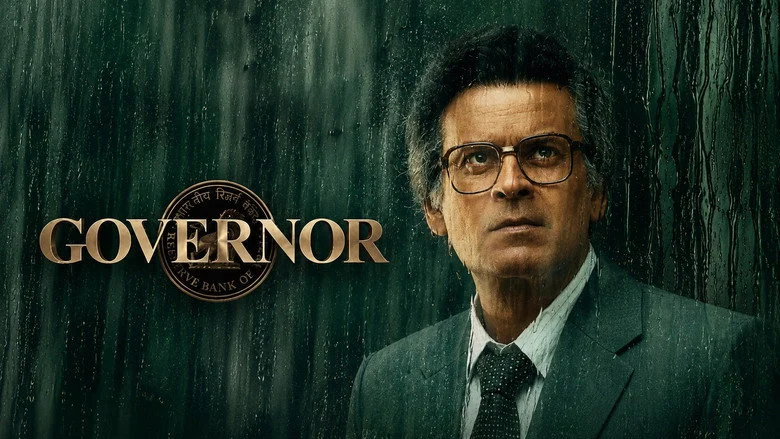
Bajpayee’s Restrained Authority in the Governor’s Chair
Manoj Bajpayee grounds the film through understatement rather than spectacle. His Raman is positioned as a reluctant administrator forced into the role during India’s 1990s economic crisis, and the casting itself signals that this is not a hero narrative but a portrait of institutional burden. The appointment sequence establishes the stakes immediately, a man stepping into a collapsing system with no margin for error. Bajpayee’s strength lies in suggesting competence through stillness, the weight of responsibility pressing down through measured restraint rather than emotional outburst.
Mandlekar’s Crisis Architecture and Screenplay Discipline
Director Mandlekar constructs the narrative around deadline-style tension: stabilize the economy before collapse deepens. The screenplay by Saurabh Bharat, Shubhendu Bhattacharya, and Mandlekar itself follows a deliberately linear crisis progression, appointment, escalation, containment attempt. This is a strength: the structure mirrors the grinding logic of institutional crisis management. Where the approach shows brittleness is in whether the dialogue and dramatic staging can sustain interest across 122 minutes of political negotiation and economic briefing. The premise demands that fiscal minutiae feel urgent, and that challenge hangs over the entire execution.
Political Thriller Machinery: Institution as Pressure Engine
The film positions the RBI Governor’s office as a pressure cooker where individual decision-making collides with political interference and systemic resistance. Economic collapse becomes the central tension, not as abstract concept but as spreading public panic, fuel shortages, and the real threat of national bankruptcy framing each scene. The tagline material emphasizes this: one decision-maker against state-level failure, no public credit, only the weight of survival.
The appointment scene establishes this engine efficiently, dropping the protagonist into a financial emergency without ceremony. What follows must sustain that institutional claustrophobia through dialogue, negotiation sequences, and the mounting pressure of choices that cannot be undone. The film’s genre execution rests entirely on whether Mandlekar can make fiscal policy decisions feel like life-or-death moments, a tall order that requires both screenwriting precision and directorial control of tone.
The crisis-montage material implied by inflation rising, fuel running low, and panic spreading across the nation suggests the filmmakers understand the visual grammar needed. But political thrillers succeed or fail on their ability to make bureaucratic conflict feel as urgent as a ticking bomb. This film either achieves that through meticulous staging and dialogue, or it collapses into talking-heads territory.
Hindi political dramas with substance remain rare enough that examining the craft matters more than dismissing the premise. Explore more Hindi Thriller reviews to see how institutional cinema continues to shape Hindi film language.
Adah Sharma’s Presence and Supporting Architecture
Adah Sharma is positioned as the female lead, though the supplied material offers no detail on her character function or emotional arc within the crisis narrative. Her casting suggests either emotional counterweight to Bajpayee’s austere Governor or institutional ally navigating parallel pressures. The supporting ensemble, Noushad Mohamed Kunju, Aryan Pushkar, Mounis Ratta, John Michael Forbes, Devaang Bagga, Umar Raza Khan, and Amitabh Pandey, remain largely undefined by available analysis.
Economic Crisis as Political Statement Without Controversy
The film arrives without documented scandal or censorship friction. Its political angle rests on the assertion that individual leadership can matter against systemic collapse, that the RBI Governor’s decisions in the 1990s deserved recognition even if public credit never came. This is institutional cinema making a quiet argument about the invisible machinery keeping the nation upright. For audiences invested in political drama and economic crisis narratives, that positioning carries weight. For those seeking entertainment detached from policy mechanics, the film offers nothing.
Chinmay D. Mandlekar has constructed a premise that works only if the craft sustains its own weight. The screenplay must make fiscal policy feel urgent; the direction must transform institutional settings into pressure chambers; Bajpayee must convince through restraint that the burden of economic collapse rests on his shoulders alone. Whether these elements align depends entirely on execution.
The film is a calculated swing at serious cinema, biographical, political, and deliberately unglamorous in its framing. For class audiences and Manoj Bajpayee admirers interested in institutional drama, watch it in theatrical format where the controlled tension of institutional settings can land properly. Those seeking conventional narrative payoffs or emotional crescendos should look elsewhere.
Governor: The Silent Saviour attempts institutional cinema with craft-first discipline, though whether that discipline translates to sustained engagement remains dependent on the precise staging of bureaucratic pressure, a 3.5 out of 5 gamble on whether policy drama can genuinely thrill.
Imtiaz Ali’s Main Vaapas review uses similar restraint in emotional registers, letting subtext carry the narrative weight.
Jatin Sarna’s Momacu verdict also relies on institutional pressure and systemic corruption as central forces.

Ankit Jaiswal is the Chief Author, covering Indian cinema and OTT releases with honest, no-filler criticism. An SEO strategist by background, he brings a research-driven approach to film writing, cutting through hype to tell you exactly what's worth your time.