Samarpit Father’s Love (2026): A Risk-Driven Sacrifice Drama That Barely Survives Its Simplicity
The moment Ashok’s crops catch fire, the frame tightens not on the flames but on his face, a man watching his future burn in silence. That sequence is the most honest in Samarpit: Father’s Love, because it externalizes the film’s entire philosophy: a father who suffers without a single shout.
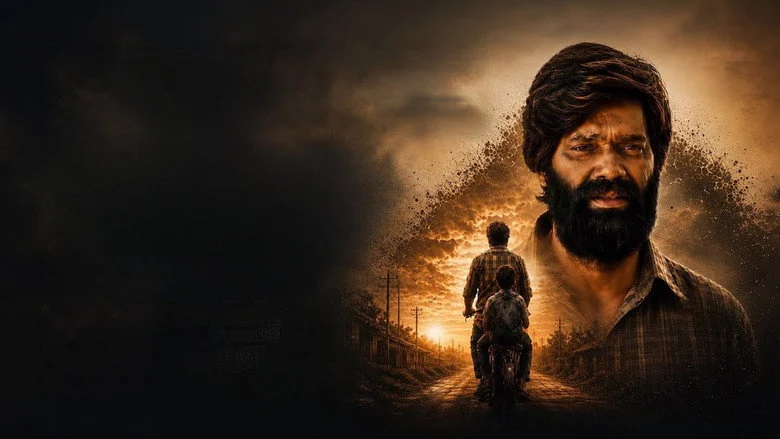
Annkit Yadavv’s Ashok: A Performance of Resignation, Not Revelation
Annkit Yadavv shoulders the entire film as Ashok, the farmer-turned-lone parent. The role demands restraint, the wife-loss-at-childbirth scene is played with a stoic stillness that feels emotionally accurate but dramatically flat for long stretches. Yadavv never overacts, but he also never finds the one moment of raw breakage that could elevate the performance from sincere to searing.
The later sequences where old age reduces his mobility and agency require a shift from silent resilience to fragile vulnerability. The shift lands, but barely.
Direction and Screenplay: A Linear Road With One Emotional Lane
Exhan Khan’s direction commits to a straightforward emotional premise, father sacrifices everything, son must reckon with it, and stays on that lane without deviation. The film avoids plot complication, which is both its stated USP and its structural limit. The screenplay, credited to Ankit Yadav and Nisha Ali, follows a chronological hardship arc that feels more like a case study than a narrative. The crop-fire sequence is the only moment where visual storytelling breaks the monotony of dialogue-heavy emotional beats. The script’s refusal to layer in subplots or secondary conflict leaves the middle section dangerously thin.
Genre-Core Execution: Drama Built on Silence, Starved of Texture
As a family drama, Samarpit: Father’s Love trusts that emotional content alone will carry the room. The narrative tension comes entirely from domestic hardship and intergenerational duty, no antagonist, no external conflict, no ticking clock. That’s a risky gamble for a Hindi drama in 2026, where audiences expect either cathartic payoff or structural invention. The film offers neither fully.
The rural father-son context grounds the stakes in recognizable class anxiety. Ashok’s sacrifice, working through hunger, losing his wife, rebuilding after the fire, is universally legible. But legibility is not enough. The genre requires at least one scene where the father’s silence breaks, or the son’s guilt becomes unbearable. Instead, the film stays on a single emotional register: muted pain.
I found myself waiting for a confrontation that never quite arrives. The climax shifts into old-age dependence, but the script frames it as inevitability rather than earned reckoning. The emotion is real, but the drama needed a sharper edge.
If you are drawn to dramas built around paternal sacrifice, browse more Hindi Drama reviews to compare how other films tackle this theme.
The Unnamed Harsh: A Son Who Exists as a Narrative Function
The actor playing Harsh is not clearly identified in the available material, which inadvertently mirrors his role in the story, present, necessary, but underwritten. Harsh exists less as a character with wants and fears and more as the emotional endpoint for Ashok’s sacrifice. The pivotal moment where the son must choose whether to care for his aging father is reduced to a generic moral beat. A stronger supporting performance, with specific choices visible in the rehearsal room, could have turned this into a dialogue of equals. Instead, Harsh remains a plot device in a film that claims to be about a relationship.
Audience Reception: Universal Emotional Core, Unknown Verdict
No verified audience scores, box office figures, or social media sentiment data are available from the supplied sources. The film was marketed as a family drama suitable for emotional viewing, and the father-son core was positioned as universally relatable. India TV Hindi called it a film that “tried to touch the fabric of middle-class families, ” while also noting that “the simplicity is its USP.” Without a critical consensus score or trade analyst commentary, the film exists in a vacuum of intent rather than impact. The lack of controversy or political angle simplifies its identity: this is a small, sincere film that never risked being misunderstood.
One Critique That Stays: The Risk of Sincerity Without Structure
Sincerity is not a shortcut. Samarpit: Father’s Love feels like a film made by people who trusted that their story’s emotional core would do the labor of craft. It doesn’t. The runtime of 1 hour 55 minutes overstays the narrative’s ability to generate new tension after the first hour. The editing splits cleanly, first half establishing sacrifice, second half turning toward dependence, but the pacing in the middle drags because no secondary arc or subplot variation exists. The music, credited to Shri Sindhu, Agni Varan, Biswajeet Ghosh, and Faraz Ahmed, is present but leaves no fingerprint on the emotional architecture. The film’s biggest risk, its refusal to add complexity, is also its most limiting weakness.
This is a film best watched at home, on OTT or a regular screen, where its modest ambitions can land without the pressure of a theatrical crowd expecting catharsis. For family audiences who prefer emotional drama over craft complexity, Samarpit: Father’s Love offers a recognizable, if uneven, portrait of paternal sacrifice. But for seasoned cinephiles, the simplicity reads more as unfinished composition than deliberate minimalism.
Samarpit: Father’s Love is a sincere but structurally flat drama that earns a sincere 2.5 out of 5, incomplete, not incompetent.
For a more layered take on intergenerational expectation, explore the uneven beats in Peddi verdict.

Ankit Jaiswal is the Chief Author, covering Indian cinema and OTT releases with honest, no-filler criticism. An SEO strategist by background, he brings a research-driven approach to film writing, cutting through hype to tell you exactly what's worth your time.