Baththa (2026): Vijay Sethupathi Anchors A Locked-Room Gangster Drama That Tests Its Own Patience
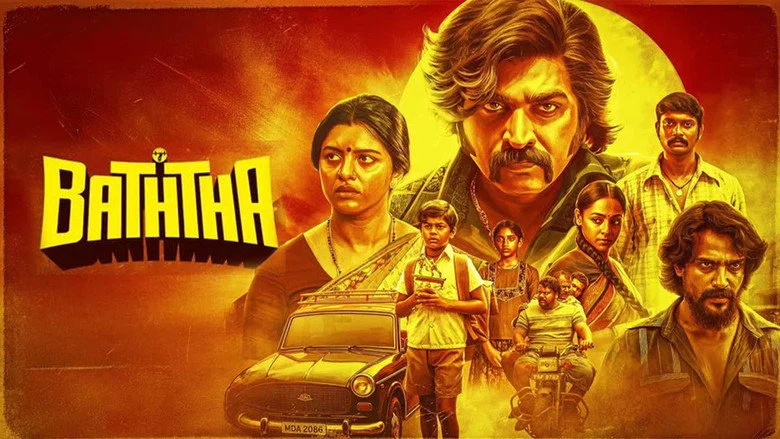
An eight-year-old boy shuts a restroom door in a deserted North Madras school. On the other side stands a gangster the neighbourhood fears enough to cross streets for. That’s the ignition point of Baththa, and it’s a genuinely elegant piece of high-concept engineering, a single child’s careless gesture converting a figure of menace into a man with nothing to do but sit with himself. For roughly the first hour, Balaji Tharaneetharan’s film understands exactly how much mileage that image can carry.
The premise is the kind that sounds like a stage play wearing a gangster’s shirt, and that’s meant as a compliment. Sethupathi’s character is introduced with the usual period-crime iconography, 1986 Madras, the smell of beedi smoke and old grudges, before the script strips all of it away and leaves him pacing a tiled room, counting hours, negotiating with his own bladder. The film’s best instincts live in that compression.
What Sethupathi Does Inside Four Walls
The performance is the reason to buy the ticket. Sethupathi has spent a career finding the soft animal underneath the intimidating silhouette, and here the screenplay hands him the metaphor outright. Watch how he plays the early restroom stretches: the practised stillness of a man who has never had to wait for anything, then the slow erosion of that stillness as hunger sets in. It’s a physical performance built on diminishing returns, the shoulders drop first, then the voice, then the eyes. By the time he’s talking to the boy through the gap, the transformation has happened without a single dialogue-heavy explanation.
The bond that develops is the film’s emotional engine, and it’s where the writing shows its Naduvula Konjam Pakkatha Kaanom DNA, Tharaneetharan has always been interested in what happens to ordinary men when circumstance removes their options. Scaling that instinct up to a period gangster canvas is a legitimate ambition. The problem is scale itself.
170 Minutes Is A Long Time To Stay Locked In
Here’s the structural hitch, stated plainly: the film runs two hours and fifty minutes, and its central device, one man, one room, one child, is inherently a chamber piece. The longer the runtime stretches, the more the screenplay reaches outside the room for incident, and the more it dilutes the very tension that made the setup sing. The middle section’s flashback-adjacent detours into family memory and gangland obligation are thematically coherent, but they arrive with a languor that the locked-room premise can’t sustain.
This is not a case of a director losing control. Tharaneetharan’s period texture is genuinely considered, the 1986 North Madras recreation has the grainy specificity of a film that respects its setting rather than using it as wallpaper. But texture isn’t momentum, and Baththa mistakes accumulation for escalation in its back half. For an instructive contrast in how a confined-premise genre piece can either commit to its compression or sprawl, our review desk’s take on HALF review is worth revisiting.
The Supporting Cast, And The Villain Who Isn’t There
Lijomol Jose is positioned as the female lead and the film’s emotional counterweight, but the screenplay gives her the kind of role that exists primarily to be remembered by the protagonist rather than to act on her own momentum. The supporting ensemble, Ajay Ghosh, Arjun Chidambaram, Hari Krishnan, Santhy Balachandran, fill out the gangland world with competent, largely functional presence. None of them are given the material to become more than texture.
More interesting is what the film does with antagonism. There is no named villain worth the term; the opposition is circumstance, hunger, time, and the protagonist’s own history. That’s a bold choice for a mass-coded action drama, and it mostly works, right up until the third act needs a conventional pressure valve and the film has to manufacture stakes it spent two hours refusing to build.
The Verdict: A Strong Idea Wearing Too Many Clothes
Baththa is a Vijay Sethupathi showcase first and a thriller second, and your tolerance for it will depend entirely on how much you trust him to hold a room. He does. The film around him is more uneven, a genuinely striking premise, a committed central performance, and a runtime that keeps insisting on more story than the concept requires. For a different angle on period-set moral reckoning in Indian cinema, our coverage of Daayra verdict offers a useful counterpoint on how a film can trust its own restraint.
See it in a regular theatre, ideally on a weekday when you can give the slow middle your full attention. Skip it if you’re arriving for fast-cut action, the film’s violence is mostly internal, and its patience is not a marketing hook. As we frequently note across Tamil Thriller reviews, the gap between a great premise and a great film is usually measured in minutes, and here it’s measured in about forty of them.
Rating: 3 / 5, Worth watching for Sethupathi’s interior work and the period craft; the bloated middle keeps it from the film it could have been.

Ankit Jaiswal is the Chief Author, covering Indian cinema and OTT releases with honest, no-filler criticism. An SEO strategist by background, he brings a research-driven approach to film writing, cutting through hype to tell you exactly what's worth your time.