Maaruvesham (2026): Vaibhav Reddy’s 30th Film Is A Whodunit That Trusts Its Clues More Than Its Characters
Srini opens Maaruvesham not with a body, but with a vocation. Thilak (Vaibhav Reddy) joins the police force for the least tactical reason imaginable, he simply likes puzzles. It is a small, characterful choice that the film returns to more than once, and it tells you what kind of mystery this is: not a procedural about jurisdiction and paperwork, but a whodunit about a man who treats a murder the way other people treat a crossword. The murder arrives, the case opens, and the film settles into its chosen rhythm, clue, revision, clue, revision, until the ground beneath Thilak’s feet is less a foundation than a series of trapdoors.
That structural instinct is the film’s signature, and it is also the thing that will divide its audience cleanly down the middle.
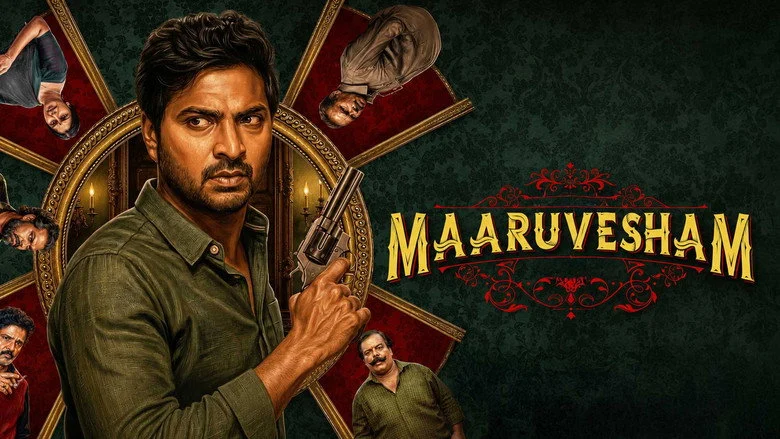
Vaibhav’s Thilak And The Discipline Of Not Overplaying The Detective
This is Vaibhav Reddy’s 30th film, and it is telling that he has chosen a police-investigation lead rather than the conventional action part his filmography might have pointed toward. Thilak is not written as a bruiser. He is written as a listener, a man whose primary investigative tool is the pause before he responds. In the film’s early stretches, Vaibhav plays the role with a deliberate flatness that reads as either restraint or under-commitment depending on your patience for it. He does not telegraph deductions. He does not do the detective-genre thing where the eyes narrow and the music swells. He simply absorbs, and lets the case do the talking.
It is a choice that pays off in the middle section, when the investigation pulls Thilak into a web of hidden identities and buried secrets, and the clues begin reshaping what the film has already told us is true. Here, Vaibhav’s stillness becomes an asset rather than a vacuum. The performance stops being about what Thilak knows and starts being about what he is willing to admit he does not know, which, in a whodunit that leans this hard on concealed identity, is the only honest posture available to a lead. Whether that restraint reads as a career-best or a missed opportunity will depend entirely on how much you need your detectives to perform their intelligence rather than simply possess it.
The Supporting Ensemble And The Problem Of Disappearing Faces
The cast list is deep, Ramki, Munishkanth, Vivek Prasanna, Livingston, George Maryan, Indhumathi Manikandan, Mu Ramasamy, Cell Murugan, Sebastian Antony, Viyana, and that depth is both the film’s texture and its structural liability. In a mystery built on hidden identities, every face on screen is a potential clue, which means the film has to give each of them just enough presence to register without giving any of them enough to give the game away. Srini manages this balancing act more often than he fumbles it, but there are stretches where the ensemble becomes a blur of recognisable character actors cycling through scenes without leaving a distinct impression.
Munishkanth and Vivek Prasanna, in particular, are the kind of performers who can steal a scene with a single line reading, and Maaruvesham occasionally seems uncertain about how much rope to give them. When it does give them rope, a glance held a beat too long, a line delivered with a shade more weight than the scene strictly requires, the film briefly becomes more interesting than its plot. Those are the moments where you feel the whodunit trying to become a character drama, and the film’s refusal to fully commit to that transformation is its most frustrating habit.
A Whodunit That Respects The Rules, Sometimes To A Fault
Srini, working from a screenplay he wrote with additional material by S. Isaiamudan, has built a film that follows the classical whodunit framework with almost religious fidelity. The premise centres on a murder case. The story uses hidden identities as its core device. Clues are said to reshape the truth repeatedly. Thilak is a cop motivated by the solving of mysteries rather than the enforcement of law. Every box is ticked, and the film’s first act establishes its rules with a clarity that suggests a filmmaker who has studied the genre carefully.
The problem with that fidelity is that it leaves little room for the film to surprise you in ways the genre has not already anticipated. Balaji K Raja’s cinematography and N. B. Srikanth’s editing keep the pace clean, there is no first-half-versus-second-half pacing collapse here, no bloated interval stretch that drains momentum, but cleanliness is not the same as distinctiveness. Rajkumar Amal’s score does the work of mood-setting without ever becoming a presence you remember after the credits. The craft is competent across the board, and competence, in a genre this crowded, is a curious kind of limitation.
For a sense of how a mystery can be anchored more forcefully by its central performance, it is worth comparing this to Baththa verdict, where Vijay Sethupathi’s presence functions as the film’s entire gravitational field. Maaruvesham does not have that luxury, and it does not try to manufacture it. Vaibhav is the centre, but he is not the whole, and the film’s willingness to share its weight across an ensemble is both a democratic instinct and a dramatic one.
Where The Film’s Instability Becomes Its Own Theme
The core theme of Maaruvesham is the instability of appearances, and the film’s structure embodies that theme more successfully than its dialogue ever articulates it. The investigation does not build toward a single truth; it builds toward a truth that keeps changing shape, and the audience’s experience of that instability mirrors Thilak’s. When a clue lands, it does not clarify, it complicates. When a character reveals something, it does not resolve, it reopens. This is the film’s smartest move, and it is the reason the whodunit mechanics feel less like a puzzle box and more like a hall of mirrors.
The cost of that approach is that the film never quite delivers the catharsis a mystery audience craves. The reveal-driven climax is there, the layered truth is uncovered, but the emotional payoff is muted, less a detonation than a slow settling. For viewers who prize the journey over the destination, that will read as sophistication. For viewers who want the satisfaction of a case closed with force, it will read as anticlimax.
There is a version of this film, and you can feel it straining to emerge in the middle section, that leans harder into the psychological cost of Thilak’s obsession with puzzles. That version would have been a character study wearing a mystery’s clothes. What we get instead is a mystery that occasionally remembers it has a character at its centre. The difference is not fatal, but it is felt.
Verdict: A Clean, Confident Whodunit That Could Have Been A Great Character Study
Maaruvesham is a well-built mystery with a lead performance that chooses restraint over showmanship, and for a certain kind of viewer, the kind who prefers their detectives quiet and their clues layered, that combination will be exactly right. The film respects its genre, trusts its audience to follow the revisions, and never insults them with cheap misdirection. What it does not do is transcend its genre, and in a landscape where the mystery-thriller has become one of Tamil cinema’s most crowded fields, transcendence is the only thing that separates a good film from a memorable one.
Vaibhav’s Thilak is a solid foundation, but the film around him never quite decides whether it wants to be about the case or about the man solving it. That ambiguity is the film’s most interesting quality and its most significant limitation. For another perspective on how a lead performance can define a film’s entire identity, our review desk’s take on Thella Kaagitham review offers a useful counterpoint, and as we frequently examine across Tamil Mystery reviews, the gap between a strong central turn and a fully realised film is often the difference between a recommendation and a reservation.
Who should watch it: Devotees of clue-driven whodunits, fans of Vaibhav Reddy’s more understated work, and viewers who value a mystery that respects its own rules over one that breaks them for shock value.
Who should skip it: Anyone hoping for action-forward police drama, and viewers who need their mystery climaxes to land with unambiguous force.
Rating: ★★★☆☆ (3/5), A disciplined, well-crafted whodunit that plays its genre straight and its lead quiet, but leaves you wondering what the louder, messier, more human version of this film might have been.

Ankit Jaiswal is the Chief Author, covering Indian cinema and OTT releases with honest, no-filler criticism. An SEO strategist by background, he brings a research-driven approach to film writing, cutting through hype to tell you exactly what's worth your time.