Nayyi Navelli (2026): Yami Gautam Dhar’s Daayan Comedy Tests the Limits of Domestic Wish-Fulfillment
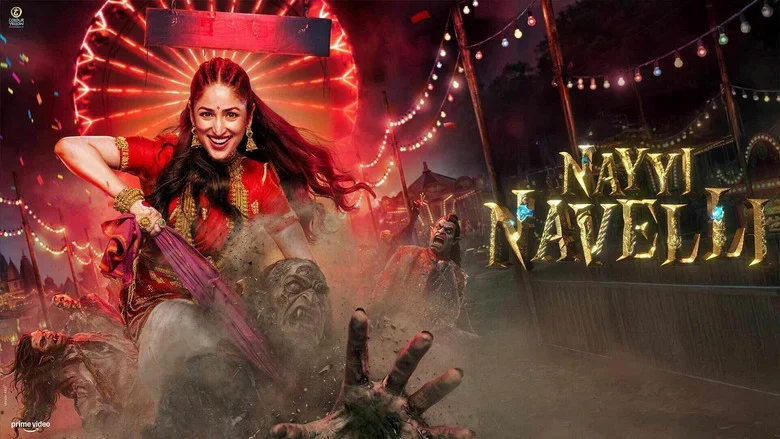
Balaji Mohan opens his film inside a Meerut household so comprehensively disordered that the arrival of any competent outsider would register as divine intervention. Yami Gautam Dhar’s Mohini walks into that chaos, and within a week the kitchen runs to clockwork, the elders stop bickering, and the family’s finances appear to self-correct.
The trouble is that perfection this total invites scrutiny, and the film’s engine is not the supernatural reveal but the brother-in-law who refuses to accept good fortune at face value.
When Domestic Harmony Becomes the Most Suspicious Evidence in the House
The screenplay, credited to Himanshu Sharma and Divy Nidhi Sharma, understands that the daayan myth has always been a story about women who are too capable, too independent, too much. By making Mohini’s competence the very thing that damns her, the film turns the joint family’s relief into an accusation.
Every folded bedsheet and perfectly timed meal becomes circumstantial evidence in a case the family never asked to open.
Where a lesser comedy would treat the household’s transformation as pure wish-fulfillment, this one lets the same image function as both comfort and threat. The comedy lands because the audience shares the brother-in-law’s suspicion even while enjoying the harmony.
The foot-inspection beat, in which Mohini is asked to display her soles for a folk test, is the film’s sharpest single idea: horror disguised as etiquette, superstition delivered with a straight face across a dinner table.
A Brother-in-Law Who Refuses the Blessing He Was Handed
The structural choice that drives the second act is elegant: the family gets exactly what it wanted, and one member cannot stop asking why. That resistance to unearned happiness is the film’s most grounded psychological mechanism, and it keeps the supernatural question tethered to recognizable domestic resentment.
The film also resists the kinetic sensationalism that overtook Don't Trouble the Trouble, opting instead for a slower, kitchen-table dread that builds through repetition rather than jump scares.
Whether that patience holds across an entire feature is the open question, and the promotional material withholds the resolution of Mohini’s identity with a discipline that could read as either confidence or evasion.
Yami Gautam Dhar Performs Two Women in One Body Without a Seam Showing
Gautam Dhar’s work here is built on a controlled double register. In the domestic passages she plays warmth as an administrative act, her hands always busy, her smile arriving a half-second before it is earned.
The restrained physical exhaustion she brings to the final confrontation recalls the psychological weight of her turn in System, where composure was also a survival strategy rather than a personality trait.
When the reveal finally arrives, the shift is not a costume change but a recalibration of the same physical vocabulary: the stillness she used to soothe the family becomes the stillness she uses to frighten it.
Adinath M. Kothare’s Raja Awasthi anchors the ensemble with a watchfulness that never tips into parody, and Mita Vashisht’s Pinky Bua supplies the extended-family friction that keeps the household from ever feeling like a single unified front.
The remaining relatives function as a chorus rather than individuals, which is a structural weakness the film never fully addresses.
Balaji Mohan Stages Suspicion Inside Household Routine, Not a Haunted Corridor
The director’s central instinct is to keep the camera at family-table distance, refusing the low angles and shadow play that would signal horror too early. The result is that the genre shift happens through behavior rather than lighting.
Just as he demonstrated a tighter spatial discipline in Ranabaali, Mohan strips away decorative camera moves here to prioritize raw psychological friction between people who share a kitchen.
The reported runtime discrepancy between cuts suggests the final edit may still be negotiating how much domestic comedy the audience will tolerate before the supernatural turn, and that negotiation is visible in the film’s uneven middle stretch.
The songs, including “Bhabhi Tabaahi” and “Phata Patakha, ” are deployed as release valves rather than narrative engines, which is a choice that serves the comedy but dilutes the dread.
Amazon MGM and Colour Yellow Bet on a Folk-Horror Comedy in a Crowded Festival Window
The commercial stakes here belong to Amazon MGM Studios and Colour Yellow Productions, two banners with very different theatrical instincts. Amazon MGM is testing whether its streaming-first muscle can translate into a festival-window Hindi theatrical release, while Colour Yellow is betting that its track record with family-forward content can absorb a supernatural pivot.
The October 16, 2026 slot places the film in direct competition with the post-Dussehra exhibition corridor, where family footfall is high but attention is scarce.
Gautam Dhar’s theatrical leverage is the real variable. She has built a following on grounded, tension-driven roles rather than spectacle, and this film asks her audience to follow her into a genre they may not associate with her.
The regional remake pipeline that has sustained Hindi comedy for a decade is showing fatigue, and an original folk-horror premise like this one is a calculated attempt to refresh the category rather than repeat it.
This patient blend of domestic comedy and folk superstition signals a welcome tonal maturity across contemporary hindi fantasys, even when the execution wobbles.
The Uncomfortable Question the Ending Leaves Behind
What the film ultimately argues is that a family’s desire for a perfect woman is indistinguishable from its fear of one, and that the daayan myth is less about monsters than about the impossibility of the role itself.
Mohini’s final reveal does not resolve that tension so much as expose it, and the film’s willingness to leave the household permanently altered is its most honest gesture.
The comedy softens what is, at its core, a bleak proposition about what families ask of the women who enter them. Nayyi Navelli does not fully earn that bleakness, but it gets closer than its marketing suggests.

Ankit Jaiswal is the Chief Author, covering Indian cinema and OTT releases with honest, no-filler criticism. An SEO strategist by background, he brings a research-driven approach to film writing, cutting through hype to tell you exactly what's worth your time.