Kitti (2026): Ashok Kumar Balakrishnan Confesses Into a Vacuum
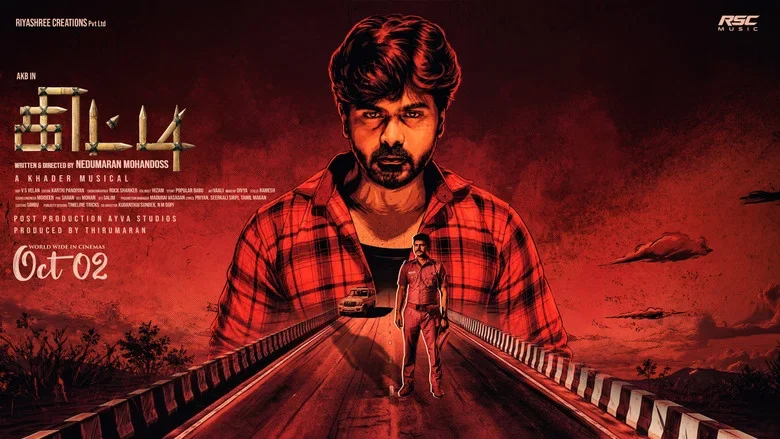
Two bodies drop in Cuddalore before the opening credits settle: a local rowdy named Siva, a college student named Pooja. Then an auto driver named Vijay walks into a police station and claims both. No chase, no forensic montage, no detective squinting at a cigarette butt. The film hands you its killer in the first act and dares you to disbelieve him.
That inversion is the entire engine of Nedumaran Mohandoss’s psychological thriller, and for roughly an hour it hums with genuine menace. Inspector Rajapandiyan registers the case, sits across from his confessor, and the interrogation becomes a duel over what actually happened. It’s a lean, mean premise, a man volunteering for the gallows while the audience quietly wonders if he’s a murderer, a mourner, or a hallucination with a driver’s license.
When the Villain Is a Man’s Own Perception, Suspense Needs Sharper Teeth
Here’s the structural gamble: there is no conventional antagonist. The opposition is distributed across the murder case, an unspoken revenge motive, social friction, and Vijay’s unstable grip on reality. That’s an ambitious spread for a two-hour runtime, and it’s also where the film starts leaking air.
Without a face to push against, the middle stretch relies on Rajapandiyan asking questions and Vijay answering them with escalating ambiguity. A tighter spatial discipline in Toxic showed how a contemporary theatrical release can weaponize restraint inside a single location; Kitti has the location but not always the restraint. The screenplay, by the director’s own construction, keeps deferring certainty, and deferral, past a point, stops being tension and starts being stalling.
The reported criticism lands precisely here. The screenplay could have moved faster, and you feel it in the second act’s refusal to commit. Every procedural beat is competent. None of them bite.
Ashok Kumar Balakrishnan Plays a Man Confessing to Something He May Not Understand
The film’s dramatic burden sits entirely on Ashok Kumar Balakrishnan’s shoulders, and he carries it with a stillness that’s genuinely unsettling. Watch his posture in the station: shoulders squared, hands loose, voice flat enough that you can’t tell if he’s calm or dissociated. When Rajapandiyan presses, Vijay doesn’t flinch, he blinks a beat late, as if the question arrived from another room.
That lag is the performance’s smartest choice. It suggests a man narrating events he half-remembers, which is exactly the uncertainty the film wants to weaponize. The role demands a slide from ordinary auto-driver to something psychologically unmoored, and Ashok manages the transition without theatrical crack-ups. The restrained physical exhaustion in his final interrogation scenes recalls the psychological weight carried through Selvi, where fatigue itself becomes the drama.
Thirumaran Mohandoss, doubling as producer and Inspector Rajapandiyan, gives the film its spine. He plays the investigator as a man who trusts paperwork more than people, and his best moments are silent, pen hovering, eyes tracking Vijay’s hands rather than his face. The two men share a room for most of the runtime, and the film lives or dies on that proximity. Mostly it lives.
The Supporting Cast Exists, and That’s Roughly the Problem
Beyond the central duel, the ensemble registers as texture rather than pressure. Nisha Ishmeet’s Pooja is a corpse before she’s a character, which is a structural choice the film never quite justifies. Sangavi Dharmaraj’s Maha moves through scenes with a natural ease that suggests a richer role than the screenplay gave her. Y. G. Mahendran’s judge and Aravindraj’s doctor arrive late to widen the frame into legal and medical territory, and both do competent work with thin material.
The royal relatives, temple elders, and assorted Cuddalore locals fill the background without ever generating the social friction the premise promises. The revenge thread and the social-problem element are woven into the investigation rather than developed alongside it, which keeps the plot tidy and the emotional stakes curiously flat. A thriller about fractured perception should feel more crowded, more contested.
V. S. Velan’s Camera Finds Freshness in an Unfashionable Setting
The film’s most reliable asset is its visual texture. V. S. Velan’s cinematography renders Cuddalore as heat, dust, and fluorescent police-station light, no glossy color grading, no drone-showmanship. The camera stays close during interrogations, favoring medium shots that trap both men in the same frame, and the effect is claustrophobic in the right way.
Sheik Khader’s songs are melodious without being memorable, and the background score does its job without ever becoming a character. The editing is where the film’s central flaw lives: the first half is question-driven and patient, the second half promises reversals and action, and the handoff between them never quite accelerates the way the material needs. The tonal shift from inquiry to confrontation reads as a gear change the film announces rather than earns.
The screenplay resists the kinetic sensationalism that overtook Baththa, opting instead for a deliberate, suffocating dread. That’s a defensible choice. It’s also a choice that requires every scene to tighten the vice, and too many of these scenes simply hold the pressure steady.
A Psychological Thriller That Trusts Ambiguity More Than It Earns It
The climax leans hard into the reality-versus-imagination premise, disclosing concealed truths while refusing to fully resolve what Vijay actually did. For viewers who came for a straight murder procedural, this will feel like a dodge. For viewers who came for a study of a fractured mind, the ambiguity is the point, but the film doesn’t quite do the psychological groundwork to make that ambiguity land as revelation rather than evasion.
The final confrontation gestures toward Vijay’s buried trauma and uncertain perception, but the screenplay withholds so much for so long that the payoff feels more like an ending than a resolution. The judge and doctor roles suggest the film wants to expand into legal and psychiatric interpretation, yet neither thread gets the screen time to complicate the central question. What’s left is a mood, a performance, and a premise that deserved a sharper third act.
This patient character study signals a welcome tonal maturity across contemporary Tamil thrillers, proving that tension can be built from interrogation rooms and unreliable narrators rather than manufactured plot theatrics. But maturity without momentum is just a slower way to lose an audience.
Kitti is a film with a genuinely original hook, a lead performance that commits to its own uncertainty, and a director who trusts his camera more than his screenplay. That’s a real foundation. What it lacks is the ruthless trimming that would turn its ambiguity into inevitability, the sense that every withheld answer was building toward a truth worth the wait. Instead, the film ends where it began: a man in a room, a confession on the table, and no one quite sure what any of it meant.
Rating: 2.5 / 5
Some confessions are acts of guilt. Some are acts of grief. Kitti never decides which one Vijay is offering, and that indecision, however intentional, is the sound of a thriller talking itself out of its own climax.

Ankit Jaiswal is the Chief Author, covering Indian cinema and OTT releases with honest, no-filler criticism. An SEO strategist by background, he brings a research-driven approach to film writing, cutting through hype to tell you exactly what's worth your time.