Sanjeev (2026): A Director Who lands hard though the screenplay stays patchy
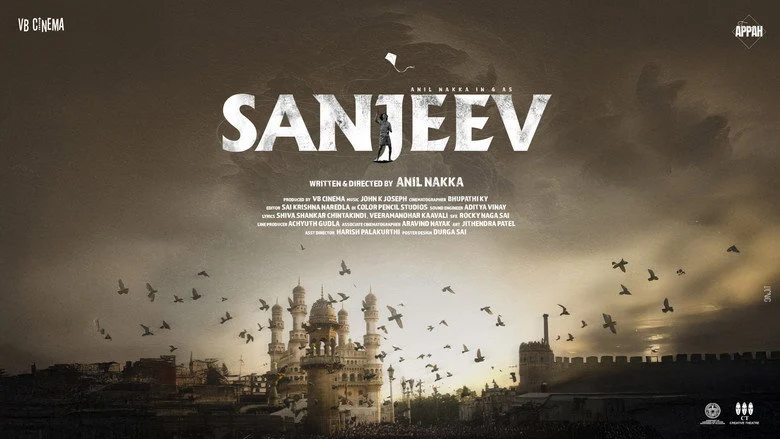
Anil Nakka’s Sanjeev opens on the dusty edges of a village, where a young man’s eyes are already fixed on Hyderabad’s skyline. The departure is quiet, almost ritualistic, a goodbye that carries more weight than the film can later sustain.
Nakka, who both directs and plays the title character, has placed an unusual bet on himself. That gamble is the single most interesting thing about this compact drama, and it’s also where the film’s limits begin.
Nakka’s Double Duty: A Centered Vision or a One-Man Show?
There is something commendable about a filmmaker who refuses to separate his craft from his body. Nakka inhabits Sanjeev with a sincerity that suggests personal investment, though the available material doesn’t reveal whether that investment translates into range.
His performance is framed around a single, stubborn desire, becoming a hero in a city that doesn’t care. The premise is clear, but the execution leaves the emotional interior largely unexplored.
What we get is a man defined by his goal rather than his contradictions. That’s a functional choice, not a revealing one.
The Screenplay’s Compression: A Blessing and a Curse
At 70 minutes, Sanjeev commits to a brevity that most Telugu dramas avoid. The linear structure from village departure to city arrival keeps the narrative legible, and there’s a certain discipline in refusing to pad the runtime with subplots.
But compression cuts both ways. The Hyderabad transition, the film’s central movement, is implied more than dramatized. We’re told about the hero-aspiration setup in the teaser, but the screenplay doesn’t appear to earn the emotional beats that should accompany such a shift.
The result is a film that feels like a sketch rather than a portrait. It gestures toward the loneliness of urban ambition without committing to the messiness that would make it resonate.
There’s a version of this story that lingers on the first night in a strange city, on the silence of a shared room, on the small humiliations of job hunting. Sanjeev, based on what’s available, seems to skip past those moments in favor of momentum.
That’s a defensible aesthetic choice, but it leaves the drama feeling undernourished.
Supporting Cast: Names Without Context
Laya Miryala appears as Pallavi, presumably the emotional anchor Sanjeev leaves behind or meets along the way. Her role is credited, but no scene-level detail exists to analyze how she grounds the narrative.
Veeramanohar Kavali’s Shiva and Hareesh Palakurthi’s Harish represent the kind of friend-group dynamics typical of such journeys. Achyuth Gudla’s Venkat rounds out the ensemble, though the research offers no indication of how these characters intersect with Sanjeev’s arc.
Their presence signals an attempt at a lived-in world, but without verifiable moments, they remain names on a call sheet rather than presences on screen.
What the Silence Tells Us: The Absence of Critical Consensus
There are no critic scores attached to Sanjeev, no publication-based praise or dismissal. That void is itself informative, this is a film arriving without a strong word-of-mouth campaign or a festival push to generate early chatter.
Audience response data is equally absent. No IMDb rating, no BookMyShow score, no social sentiment to measure against.
For a viewer, that means walking in blind. The film’s target audience, fans of concise Telugu dramas and aspiration-driven narratives, will find the premise familiar. Those expecting a commercial entertainer’s scale should look elsewhere.
I suspect the film’s fate rests entirely on whether Nakka’s dual role can carry the weight of a story that offers no distractions.
For those interested in how compact storytelling fares across Indian cinema, the landscape of Telugu Drama reviews offers plenty of comparison points.
The Verdict: A Modest Experiment Worth a Matinee
Sanjeev is not a film that will dominate conversations, but its 70-minute runtime makes it a low-commitment watch for those curious about Nakka’s gamble. Go in expecting a lean, character-focused drama rather than a spectacle, and you won’t be disappointed.
Skip it if you need your dramas to leave bruises. This one is content to graze the surface.
Sanjeev earns a 2.5/5 for its disciplined brevity and Nakka’s committed double act, but it never quite finds the emotional gear its premise promises. Those who appreciated the quiet defiance of TOY GUN review may find a similar minimalism here, though with less narrative ambition.
For a sharper take on ambition and identity, Ram Leela verdict offers a more daring, if uneven, exploration of the same themes.

Ankit Jaiswal is the Chief Author, covering Indian cinema and OTT releases with honest, no-filler criticism. An SEO strategist by background, he brings a research-driven approach to film writing, cutting through hype to tell you exactly what's worth your time.